
The “Wait, How Did It Know?” Moment
Imagine you are scrolling through a mobile storefront, eyeing a pair of rugged hiking boots. You’re mentally preparing for a trip to Zion National Park, weighing the merits of ankle support against breathability. Before you even reach for the “Specifications” tab, a discreet notification pulses at the bottom of your screen. A mobile AI assistant—not a clunky pop-up, but a fluid interface—whispers: “Hey! These have the specific Vibram grip you’ll need for the steep inclines of Angel’s Landing. By the way, they’re 10% off for the next sixty minutes.”
You pause. A slight shiver of recognition hits. How did it know?
We have officially moved beyond the era of “Hi [First_Name]!” email templates. We have entered the age of Agentic Commerce. This shift represents a fundamental pivot in how brands interact with us. It isn’t just about who you are in a database—a 30-something professional living in a specific zip code—it’s about what you are doing in this exact millisecond.
Through Real-Time Intent Mapping, AI no longer waits for you to tell it what you want. It observes your “micro-behaviours.” It measures your “scroll velocity”—the speed at which you breeze past lifestyle photos versus the “hover time” you spend on a price tag or a sizing chart. By analysing these digital breadcrumbs, the system distinguishes between a casual “researcher” and an “urgent buyer” with a level of precision that feels almost telepathic.
How We Got Here: From TV Ads to Mind Reading
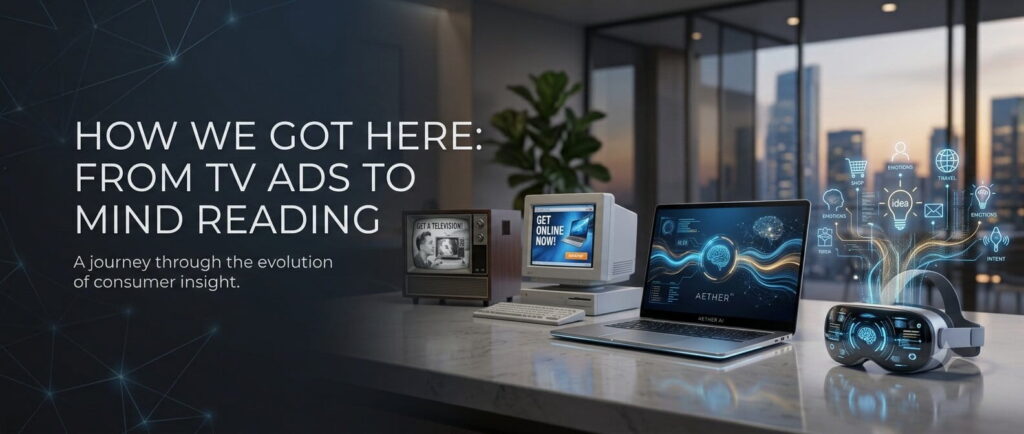
To appreciate the gravity of this shift, we have to look back at the relative crudeness of our retail history. For decades, we lived in the Stone Age of Mass Marketing (1950s–1980s). Brands shouted at us through television and radio, treating the entire population as one giant, homogenous block. If you saw a Snickers commercial, it was because you happened to be watching the same channel as ten million other people.
Then came the “Amazon” Awakening (1990s–2000s). This was the era of reactive personalisation. We marvelled at the “Customers who bought this also bought…” widget. It felt like magic at the time, but in the rearview mirror, it looks as clunky as a rotary phone—a simple game of correlation based on past purchases rather than current desires.
The Creepy Middle Years (2010s) introduced us to the “abandoned cart” email. If you looked at a toaster and didn’t buy it, that toaster would follow you across every social media platform for three weeks like a lost, desperate puppy. It was personalised, yes, but it was also static and often annoying.
Today, we have buried the “Static Persona.” Retailers are realising that the “Soccer Mom” or “Tech Enthusiast” segments are useless because people are multi-faceted. Instead, they use Dynamic Micro-Segments that refresh with every click. You might be a “budget-conscious parent” at 2:00 PM and a “luxury-seeking hobbyist” at 9:00 PM. The AI now evolves as fast as your mood does.
The Cool Kids’ Table: Current Trends and the “Rufus” Effect
In the current landscape, hyper-personalisation has moved from being a competitive advantage to a baseline for survival. If a retailer doesn’t “get” you within the first three seconds of a mobile session, they become invisible—especially to Gen Alpha and Gen Z shoppers who have zero patience for irrelevant content.
Consider the “Rufus” Effect. Amazon’s generative AI shopping assistant, Rufus, represents a watershed moment. Data shows that shoppers who engage with these sophisticated, multi-modal agents are 60% more likely to complete a purchase. These aren’t the frustrating decision-tree bots of 2016; these are Large Language Model (LLM) powered partners that use Retrieval-Augmented Generation (RAG) to check live inventory and offer genuine advice.
This has birthed a new frontier: AEO (Answer Engine Optimisation). In the past, brands fought to be the #1 link on a Google Search result (SEO). Today, that is no longer enough. Now, brands want to be the only answer a chatbot provides when a user asks, “Which boots are best for Zion?” If you aren’t the AI’s top recommendation, you don’t exist.
The “Stop Being Weird” Factor: Ethics and the Trust Gap
As an observer of this tech evolution, one cannot ignore the “creepy factor.” There is a fine line between being helpful and being invasive. This is the Trust Gap: while 87% of shoppers find AI-driven experiences valuable, 64% are deeply concerned about how their data is being harvested.
We are seeing the rise of Surveillance Anxiety. The fact that a store tracks your “hesitation data”—measuring the microseconds you spent debating a price—can feel like a violation of mental privacy. Furthermore, there is the dark side of Digital Redlining and dynamic pricing. Is the AI charging you $5 more for those boots because you’re browsing from an iPhone in a wealthy neighbourhood?
There is also the risk of Inferred Sensitivity. AI is now powerful enough to infer health issues, financial distress, or even pregnancy based on benign shopping habits. We’ve already seen legal ramifications for this, such as the £1.5M fine against Easylife for using personal data to infer health conditions. As these profiles become “permanent behavioural blueprints,” the stakes of a data breach become astronomical. We aren’t just losing credit card numbers anymore; we’re losing the maps of our subconscious.
Shopping in 2026 and Beyond: The Matrix Mall
Where does this lead? By 2026 and beyond, the traditional sales funnel will likely collapse into a single, proactive dialogue.
We are moving toward the era of the “Authorised Buyer.” Soon, you won’t even “shop” for essentials. Your AI assistant will act as a delegated agent, negotiating prices with a retailer’s AI (Agent-to-Agent or A2A protocols) and executing the transaction while you sleep. This is Ambient Commerce—where your fridge, your wearables, and your home assistant manage your life’s inventory autonomously.
We will also see the full integration of Spatial Computing. Imagine wearing AR glasses and “dropping” a 3D model of a sofa into your actual living room. As you walk around it, a 3D avatar—a digital personal shopper—walks with you, discussing fabric durability and current market resale value via Digital Product Passports.
Real-World Execution Example: The Next-Gen Premium Laptop Category
To understand how Agentic Commerce modernises high-stakes electronics retail, look at the premium computing market. Consider a major consumer electronics OEM marketing its latest premium computing flagship.
In this category, buyers are heavily analytical. They routinely balance raw computing thresholds against daily portability. When a buyer visits the portal, traditional marketing platforms treat them as an anonymous cookie to be retargeted with ads for the next month.
Agentic commerce observes the digital interaction instantly. If a user spends significant time reviewing graphic processing specifications or expansion ports, the intent mapping engine calculates a high-intent consideration curve. Instead of initiating an intrusive sales pitch, a contextual AI assistant arrives to directly answer deep technical questions, removing purchase anxiety in real time.
Step-by-Step Implementation Guide for Premium Laptop Category
Deploying an intent-driven, agentic retail architecture requires moving beyond legacy e-commerce templates toward an integrated, ecosystem-focused sales framework.
Step 1: Map Digital Hesitation with Precision Analytics
The foundation requires capturing precise user engagement behaviours across high-value product pages.
- Implement real-time interaction tracking that measures technical spec expansions, comparison tool usage, and component customisation behaviour.
- Example: A visitor views the laptop product page and spends consecutive minutes expanding details on the Intel Core Ultra processor and NPU metrics. The platform registers this micro-behaviour as an advanced creative or professional intent profile.
Step 2: Implement Technical Conversational Discovery Engines
Ditch basic keyword search functions for an enterprise-level, large language model (LLM) powered interface capable of synthesising specialised technical documentation. Connect your conversational AI directly to hardware architecture schemas, localised inventory systems, and compatibility matrices.- Example: When a customer asks the storefront assistant, “Can this laptop handle heavy 3D rendering workflows and external multi-monitor configurations while travelling?” the AI uses its knowledge graph to explain specific NPU capabilities and port layouts instantly.
Step 3: Shift to Ecosystem-Driven Value Bundling
Protect margins and retail partnerships by using real-time intent insights to design comprehensive value configurations rather than dropping device prices. Build an automated configuration engine that dynamically introduces high-margin ecosystem accessories and protection layers based on the consumer's behaviour.- Example: When an analytical user pauses at the checkout step for a premium laptop, the system surfaces a customised bundle incorporating a complementary device sleeve or a discounted protection plan, increasing transaction value without lowering hardware margins.
Step 4: Establish Automated Device-to-Retailer Commerce (A2A)
Prepare for an ecosystem where consumer applications and home platforms negotiate directly with vendor distribution pipelines. Develop secure application programming interfaces (APIs) designed to read, verify, and fulfil procurement requests sent by external personal consumer agents.- Example: A consumer’s personal scheduling agent identifies an upcoming international business trip and connects directly with the electronics platform to locate, configure, and secure an eligible device bundle before departure.
Step 5: Coordinate Fulfilment Across Omnichannel Networks
Keep operations running smoothly by linking direct online interactions with localised physical retail inventory. Integrate the online agentic engine directly with national retail store inventories and regional distribution nodes.- Example: Once the digital assistant completes the purchase terms, the order is routed to the authorised partner location closest to the consumer for immediate contactless store pickup.
Conclusion: The Persona is Dead, Long Live the Intent
The most profound takeaway from this shift is that the “Target Market” is a relic of the past. Retail is no longer about categorising people into boxes; it is about engaging in a living, breathing conversation with a “segment of one.”
The persona is dead. In its place is a map of intent that shifts from millisecond to millisecond. As we navigate this new world of Agentic Commerce, the goal for brands is no longer just to sell us something—it is to anticipate us.
The next time a chatbot seems to know exactly what you’re thinking before you’ve even typed it, don’t be alarmed. It’s just the new language of commerce. Just make sure it gets you that 10% discount.
