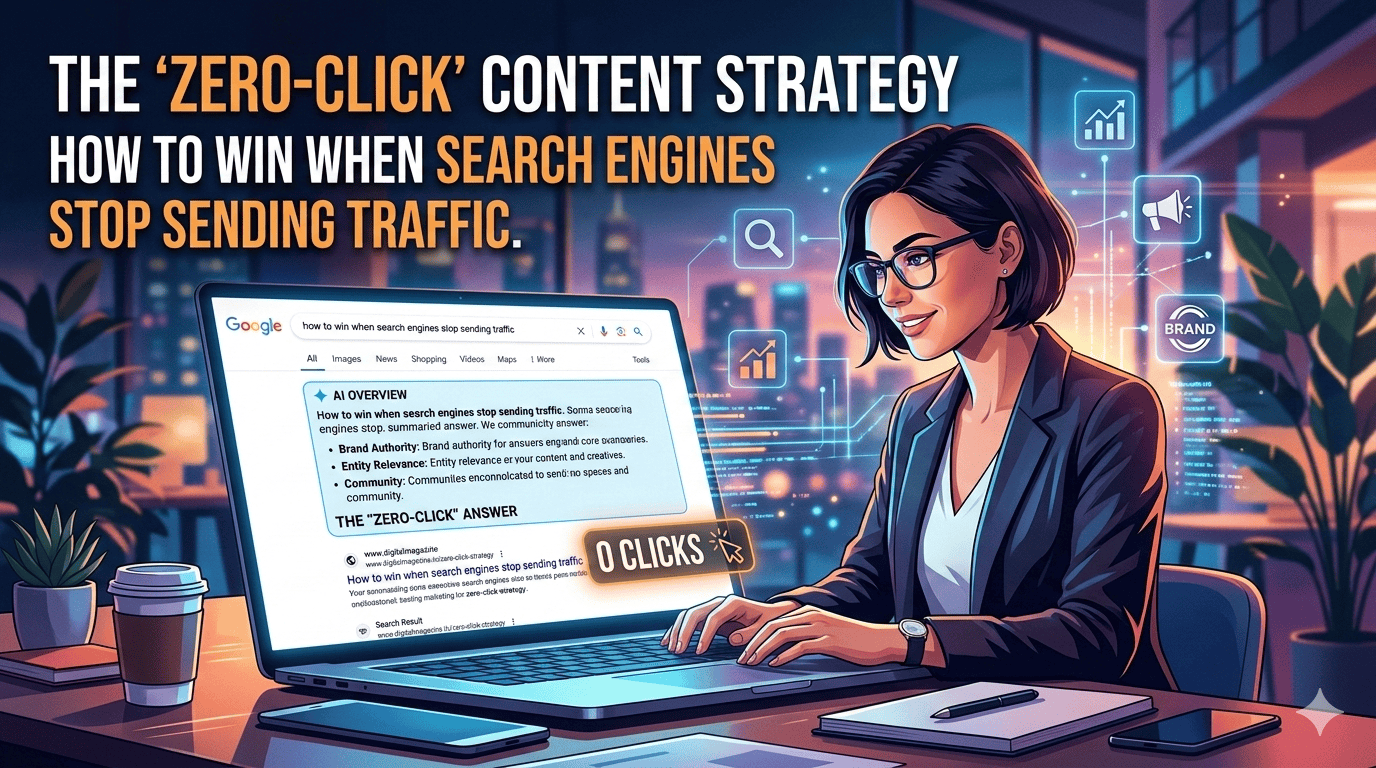
The era of “rented” attention is coming to a violent end. For two decades, digital marketing operated on a simple, predictable contract: you create content, Google indexes it, and in exchange, you receive a steady stream of clicks. That contract has been torn up.
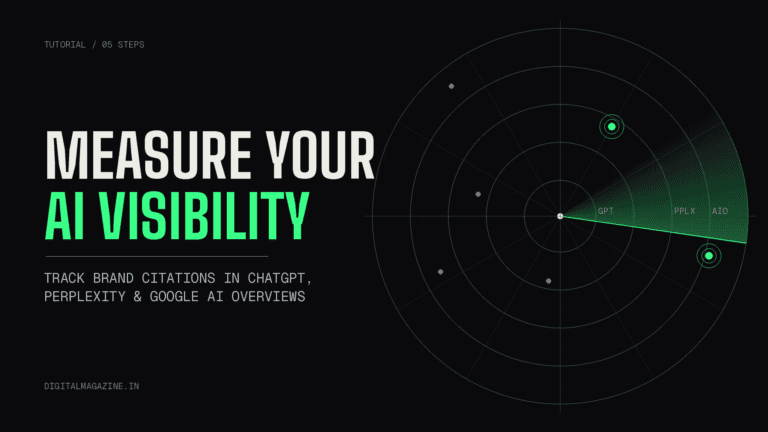
If you are still measuring your success primarily through organic sessions in Google Analytics, you are effectively watching a sinking ship while admiring the woodwork. The replacement scoreboard exists: tracking your brand’s citations across ChatGPT, Perplexity, and AI Overviews gives you the visibility metric that organic sessions no longer capture. The reality is that search engines are no longer “gateways” to the web; they are becoming the “destination” itself. Between Featured Snippets, Knowledge Panels, and the aggressive rollout of Search Generative Experience (SGE), the “Zero-Click” reality is here.
This isn’t just a trend. It is a fundamental shift in how humans consume information. If you want to survive, you need to stop chasing clicks and start chasing “Mindshare.” Here is how you win when the search engines decide they no longer want to share their traffic with you.
1. The Mirage of the Search Result
Let’s be honest: Google’s primary loyalty is not to publishers. It is to its shareholders and its users. Providing a list of ten blue links is a friction-filled experience for a user who wants to know “What is the best fabric for the Indian summer?” or “How do I automate my CRM?”
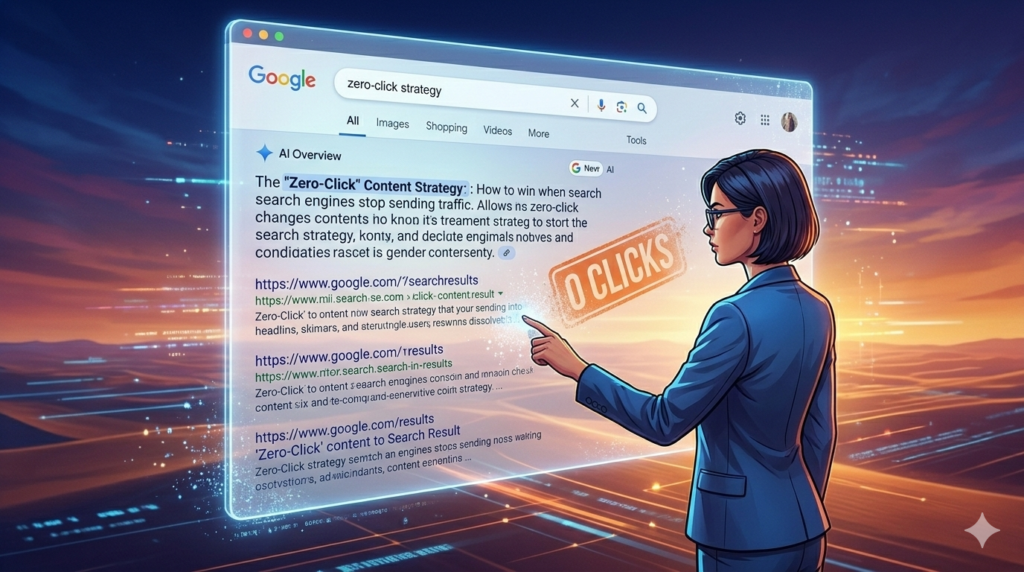
When Google provides the answer directly on the results page, the user is satisfied. Google wins because the user stays on its platform and sees its ads. You, the creator, lose the click. Data shows that over 60% of Google searches now end without a single click to a non-Google property. In mobile search, that number is even higher.
The industry calls this “Zero-Click Search.” I call it the “Information Tax.” Google is taxing your content by taking the value (the answer) and keeping the currency (the traffic). To fight back, you must stop building libraries that Google can easily summarise. You must build a brand that people seek out by name.
To understand the timeline of this evolution, it is worth looking back at the predictions made in Search in 2025: Preparing for AI-Driven Search Engines. We are seeing those predictions materialise faster than anyone anticipated.
2. The Information Gain Factor: Why “Better” is the Enemy of “Different”
Most content on the web today is a copy of a copy. A marketing team looks at the top three results for a keyword, “skyscrapers” and the content by adding 200 more words and a few more images, and hopes to outrank them.
AI models—the very ones powering today’s search engines—love this kind of content because it is predictable. They can ingest your “Ultimate Guide to SEO” and summarise it in three bullet points. If your content can be summarised without losing its soul, it is officially redundant.
Information Gain is the only moat you have left. This is a concept where search engines reward content that provides new information that isn’t present in other results.
If everyone is writing about “How to use AI for SEO,” and you write the same thing, you will be buried. But if you write about “Why our brand stopped using AI for SEO and saw a 40% increase in conversion,” you have provided information gain. You have shared a unique data point, a specific failure, or a controversial opinion that an LLM cannot synthesise from generic data.
You need to move away from being a “publisher” and start being a “source.” Sources get cited by AI; publishers just get scraped.
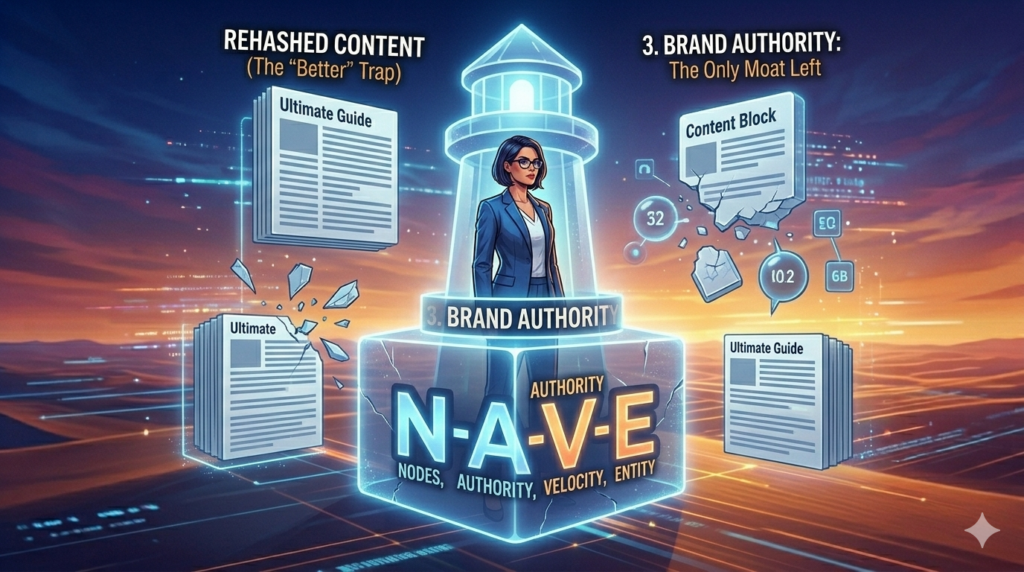
3. Brand Authority: The Only Moat Left
In a world where AI-generated answers are everywhere, “Who said this?” becomes more important than “What was said?”
We are entering the “Era of Trust.” When a user sees an answer in a Google AI Overview, they are starting to ask: Can I trust this? If the answer is attributed to a brand they recognise and respect, the value of that “Zero-Click” impression is massive. Even if they don’t click, your brand has occupied a space in their brain.
This is where your Ethical AI and Data Privacy efforts come into play. Transparency and authority are not just legal requirements; they are marketing assets.
To win at Zero-Click, you need to optimise for N-A-V-E (Nodes, Authority, Velocity, and Entity):
- Nodes: Be mentioned in the right circles (backlinks are now just a signal of a relationship).
- Authority: Have authors with verifiable credentials.
- Velocity: How often is your brand being searched for by name?
- Entity: Does the “Knowledge Graph” understand exactly what your business does?
If you want to stay relevant, you must ensure that your technical foundation is built for this. Using AI for a Smarter SEO Strategy can help you identify these entity gaps, but the “human” authority must be real.
4. The New Technical Stack: Optimisation for LLMs (LLMO)
Traditional SEO was about keywords and meta tags. Zero-Click SEO is about Schema and Semantic Clarity.
When an AI like Perplexity or Gemini “reads” your site, it isn’t looking for a 2% keyword density. It is looking for structured data that helps it understand the relationship between concepts. You need to become an expert in JSON-LD. You need to tell the machines exactly what your data means so they have no choice but to cite you.
But here is the “Forward-Thinking” catch: Don’t just give the machines the answer. Give them the “Why.”
If you provide a simple table of “Top 5 Marketing Tools,” Google will take that table and show it on the SERP. You get zero traffic. However, if your content is structured as “A proprietary framework for evaluating marketing tools based on 500 hours of testing,” the AI is more likely to provide a summary that includes your brand name as the “evaluator.”
We previously discussed how tools can help in 5 Free AI Tools to Supercharge Your Content Creation, but the strategy must be to use these tools to enhance human insight, not replace it. If an AI writes your content, why should an AI search engine bother sending people to see it? It already knows what you’re going to say.
5. The Pivot to Owned Communities and “Dark Social”
If the search engines are stopping the flow of traffic, you must build your own pipes. The “Zero-Click” strategy isn’t just about winning on the search page; it’s about making the search page irrelevant to your bottom line.
Dark Social—the sharing of content via private channels like WhatsApp, Slack, and Email—is where the real conversion happens today. People trust a link from a colleague more than a snippet from an AI.
To win here, your content needs to be “Portable.”
- Charts and Data Viz: Create images that are so useful people copy-paste them into their internal slide decks.
- Controversial Opinions: Write things that make people say, “Did you see what [Brand] said about the death of performance marketing?”
- Tool-Based Content: Instead of an article, build a calculator or a template. People bookmark tools; they skim articles.
As we noted in AI-Powered Dynamic Customer Journeys, the journey is no longer linear. It is a messy web of touchpoints. If search is only one small touchpoint that doesn’t even result in a click, you must ensure you have captured that user’s attention elsewhere—likely via a newsletter or a direct community.
6. Measuring Success in a Clickless World
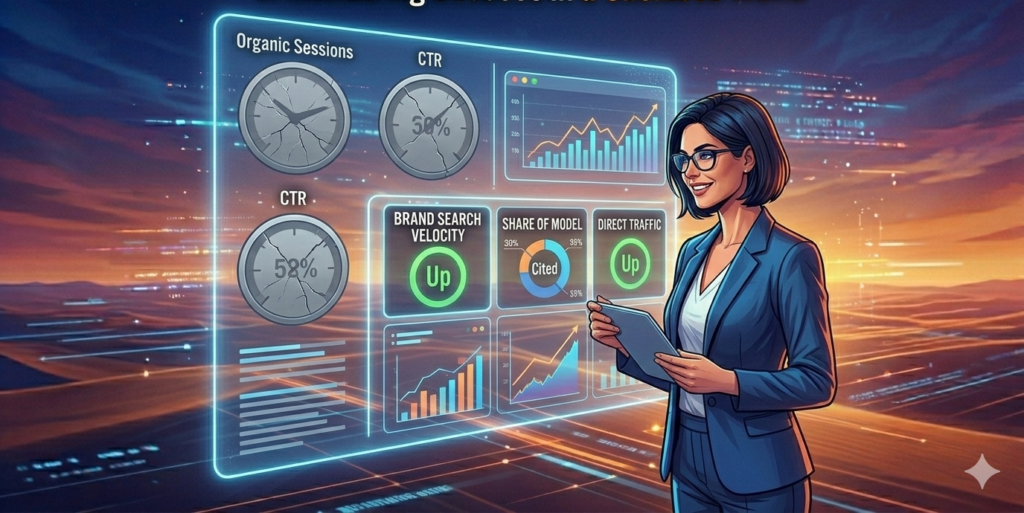
We need to stop the obsession with Click-Through Rate (CTR). In a Zero-Click world, CTR is a dying metric. Instead, start measuring:
- Brand Search Volume: Are more people searching for “Your Brand + [Topic]”?
- Share of Model (SoM): When you ask ChatGPT or Gemini for a recommendation in your niche, does it mention your brand? This is the “Share of Voice” for the 2020s.
- Direct Traffic: Are people coming straight to your URL?
- Zero-Click Conversions: This is harder to track but essential. It involves using post-purchase surveys (“How did you hear about us?”) to find the people who saw your answer on a search page, didn’t click, but remembered you later.
If you don’t change your KPIs, you will fire your best content creators because their “traffic” is down, even as their “influence” is up. That is a recipe for corporate suicide.
7. The Death of the “Skyscraper” and the Birth of the “Deep Dive”
The “Skyscraper Technique” (making a longer version of existing content) is dead. It was based on the idea that “more” is “better.” AI has made the marginal cost of “more” zero. Anyone can generate a 5,000-word article in thirty seconds.
The “Deep Dive” is different. A deep dive is an opinionated, data-backed, and experience-heavy piece of writing. It doesn’t care about being the “Ultimate Guide.” It cares about being the “Most Interesting Perspective.”
In the context of The Future of SEO: What Happens If ChatGPT Replaces Search Engines?, the answer is clear: the machines will handle the facts; humans must handle the meaning.
If a user asks, “How do I set up a Shopify store?”, Google will give them the steps. Zero clicks for you. But if a user is browsing and sees an article titled “Why 90% of Shopify Stores in the Apparel Niche Fail in the First 6 Months (And the 3 Things the Winners Do Differently),” they will click. Why? Because that requires human judgment, nuance, and failure. AI is bad at failure. It only knows “average” success.
Conclusion: Adapt or Extinguish
The “Zero-Click” content strategy is not about giving up on SEO. It is about evolving SEO into a “Brand Discovery” engine.
Stop treating your website like a destination that people must visit and start treating it like a “Truth Server” that feeds the entire internet. If your information is so good that Google wants to steal it for a snippet, let them—but make sure your brand name is so deeply embedded in that information that the user can’t help but remember who the expert is.
The future of the web is not a series of links. It is a series of answers. Your job is to be the only entity that the answers point back to, whether a click happens or not.
Tell it like it is: the “Golden Age” of easy SEO traffic is over. We are now in the “Iron Age” of brand building. It’s harder, it’s heavier, and it requires much more heat. But the structures you build now will be the only ones still standing when the search engines finally close their doors to external traffic for good.
Focus on Information Gain, invest in Semantic Authority, and build a Community that doesn’t need a search engine to find you. That is how you win the Zero-Click game.