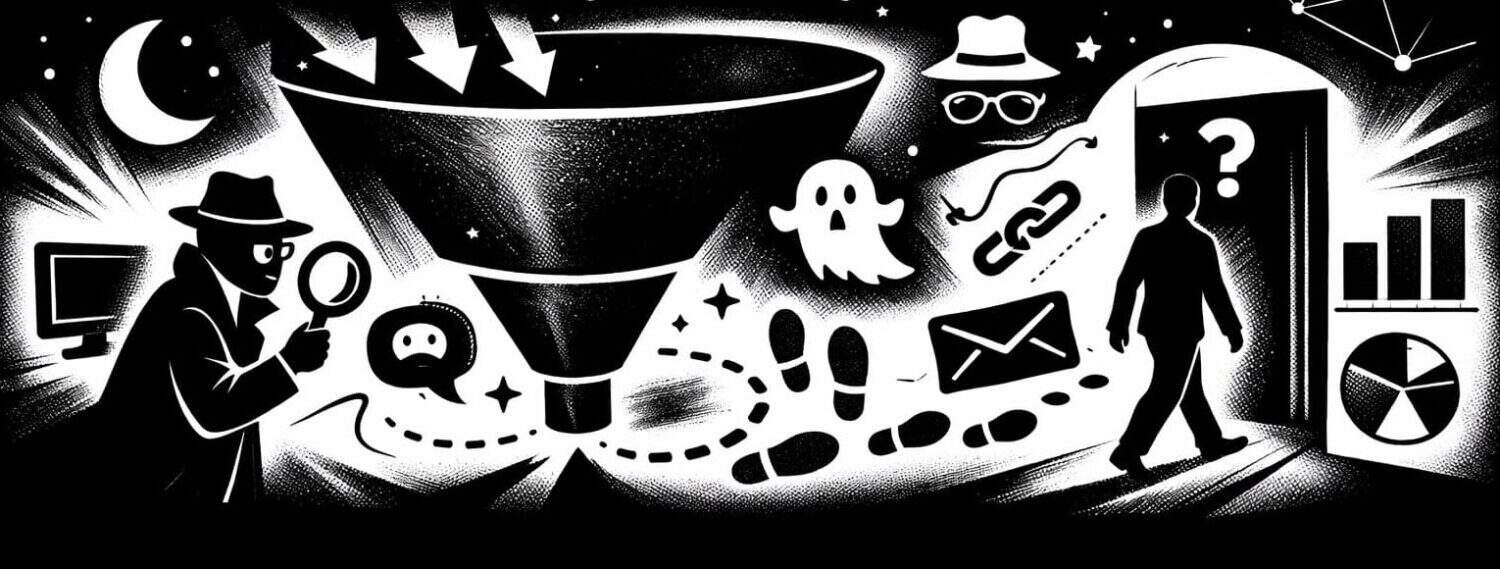
Your pipeline numbers look fine. Deals are moving. The dashboard is green. And then a prospect gets on a discovery call and says, “Yeah, we’ve been following you guys for about eight months.”
Eight months. And your CRM shows them as a new lead.
That gap has a name: the dark funnel. And for most B2B companies, it’s not a small blind spot – it’s the majority of the buying journey. If you’re still making budget decisions based purely on what’s trackable, you’re working with less than half the picture.
What Is the Dark Funnel in B2B Marketing?

The dark funnel covers every piece of research, every conversation, and every piece of content a buyer consumes before they ever click a link you can trace. It’s the Slack thread where someone asks, “Has anyone used your product?” It’s the podcast your buyer listened to on their commute. It’s the G2 review page they visited three times in a week. It’s the forwarded email from a trusted colleague.
None of it shows up in your attribution dashboard. All of it influenced the deal. And the newest dark-funnel channel is the biggest one yet: buyers asking ChatGPT and Perplexity for recommendations. That corner of the funnel is partially measurable now – our AI visibility measurement tutorial shows how.
The term was first used by 6sense, and while it sounds dramatic, the concept is straightforward: buyers make up their minds in spaces you can’t monitor, well before you know they exist.
Why the Problem Is Bigger Than We Realise
Here’s the number that should sit uncomfortably with every marketing leader: according to 6sense’s 2025 Buyer Experience Report, based on responses from more than 4,000 buyers across North America, EMEA, and APAC, buyers don’t engage with sellers until they’re roughly two-thirds of the way through their buying journey. They initiate outreach themselves over 80% of the time and overwhelmingly reach out first to the vendor they intend to buy from.
Two-thirds. Gone. Invisible. By the time someone fills out your demo form, they’ve already done the research, shortlisted the vendors, and in most cases picked a favourite.
It gets sharper from there. 94% of buying groups ranked their preferred vendors before making first contact with any of them, and they ultimately purchased from that preliminary favorite 77% of the time. The window where marketing can actually shift a buyer’s decision is earlier – and shorter – than most go-to-market strategies account for.
And the shortlist problem is severe. Buyers choose from one of the four vendors on their Day One shortlist 95% of the time. If you’re not in that consideration set before the buyer officially “starts” their process, you almost certainly won’t win the deal – no matter how good your nurture sequence is.
This is why the dark funnel isn’t just a measurement problem. It’s a revenue problem.
The Channels Living in the Dark
Understanding where buying decisions form – outside your CRM, outside your pixels, outside your attribution stack – is the starting point for any serious dark funnel marketing strategy.
Dark Social
This is the most misunderstood channel in B2B. When someone shares your blog post via a WhatsApp message, forwards your pricing page in a Slack thread, or pastes your product link into a Microsoft Teams chat, the referral source gets stripped. Your analytics reports it as “direct traffic.”
According to RadiumOne’s research, based on analysis of 940 million users, 84% of content is shared through emails and private messaging tools rather than public social networks. That’s not a marginal figure. It’s the majority of sharing behaviour, completely invisible to standard analytics.
Podcasts and Audio
There’s no pixel on a podcast. No UTM on a Spotify episode. But when a founder appears on a RevOps show and a prospect mentions it on their first sales call, that’s pipeline influence that happened months earlier – in a channel your attribution model never touched. Podcasts have become a primary trust-building mechanism in B2B precisely because they’re long-form and feel nothing like traditional advertising.
Peer Communities and Private Forums
Slack communities, Discord servers, niche subreddits, and invite-only LinkedIn groups – this is where practitioners go to ask real questions and get real answers from people who have no reason to pitch them. These conversations are impossible to track and often the most influential in the entire B2B buying journey.
Third-Party Review Sites
G2, Capterra, and TrustRadius sit entirely outside your owned channels. Buyers trust them precisely because you don’t control what’s written there. The trajectory of trust in these platforms is stark: public product review websites were the most consulted information source for 31% of buyers in 2024 – up from 23% in 2023, 18% in 2022, and just 13% in 2021. Buyers also chose independent software review sites over analyst firms at every stage of their purchasing journey.
That trend has now extended into AI-mediated discovery. 87% of buyers say AI search has changed how they research software, and half of buyers now start their research with an AI chat tool – with answers from those tools being twice as influential as salespeople. Review site presence now drives both direct buyer research and AI-generated vendor recommendations simultaneously.
Word of Mouth
Still the highest-converting channel in existence. Still almost impossible to track at scale. A warm referral from a trusted colleague compresses a buying cycle from months to weeks – and your attribution tool will credit it to “organic” or “direct.”
Why Your Attribution Model Is Quietly Defunding What Works
This is where it gets uncomfortable.
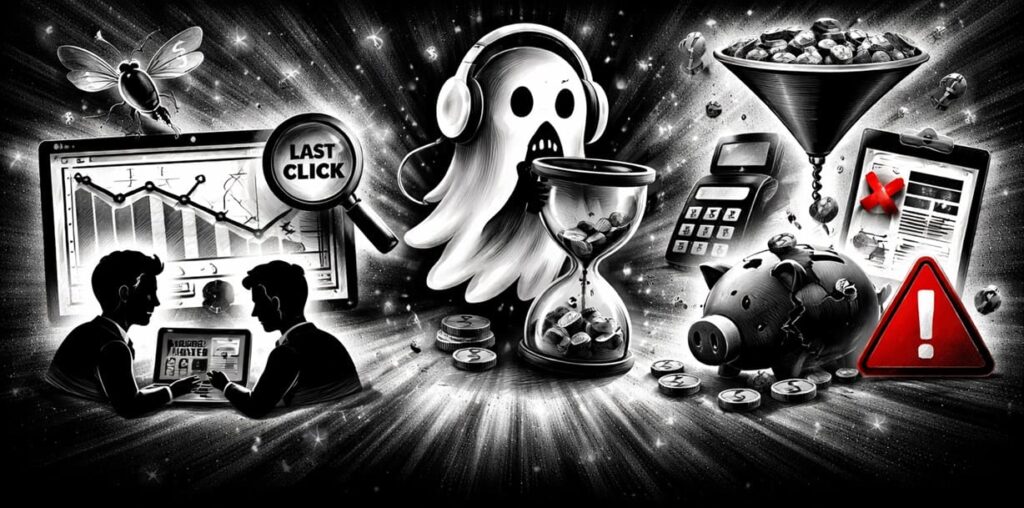
When you optimise purely for what’s measurable, you create a feedback loop that defunds the channels driving the most actual influence. Your paid search numbers look excellent on paper because it’s fully trackable. Your podcast sponsorship or community presence looks like a rounding error. So you shift budget toward paid and pull back on brand. The next quarter, your “measurable” pipeline holds steady – but your close rates dip, and your sales cycles lengthen. No one connects the dots.
You can’t buy your way out of this with a better attribution platform. The problem isn’t the tool. It’s the assumption that what’s measurable is representative.
The 6sense research makes the structural issue explicit. By the time sellers are brought in, the choice has largely been made. What follows during the final third of a buying process isn’t a selection process – it’s a validation process dressed up as a sales cycle, with sales playing the part of supporting player rather than protagonist. That means every dollar you’re spending on late-stage nurture and sales enablement content is competing for influence that was decided before your funnel even registered the account.
The content consumption data reinforces this. According to 6sense’s own research, buyers consumed an average of 13 content pieces during their journey – eight from vendors, but five from third parties. Those external sources often carried greater weight in final decisions, even though buyers consumed more vendor content by volume.
More vendor content doesn’t mean more influence. Third-party validation – reviews, peer conversations, independent analysis – is what shapes the shortlist. And that’s almost entirely happening in the dark funnel.
This connects directly to how brand-building and organic channels interact across search and social. Our piece on Social SEO: How to Rank on TikTok, YouTube, Instagram, and Beyond in 2026 covers how content distribution across untracked channels feeds directly into dark funnel influenceHow to Measure What You Can’t Track
The goal here isn’t perfect attribution. Perfect attribution doesn’t exist, and chasing it wastes more budget than the gaps themselves. The goal is directional clarity – enough signal to make defensible budget decisions.

Self-Reported Attribution
The simplest and most underused tool in the stack. Add a required open-text field to every high-intent form – demo requests, pricing pages, contact forms – asking: “How did you first hear about us?”
Not a dropdown. An open field. The answers are messy, but they’re honest. The mismatch between what people say in that field and what your analytics dashboard reports is exactly where your dark funnel lives.
SparkToro, the audience research platform founded by Rand Fishkin, publishes consistent research on how self-reported attribution diverges from tracked attribution – and the gaps are reliably large across B2B categories.
Pipeline and Win/Loss Interviews
Post-close and post-loss conversations with buyers are among the highest-signal data sources available to CMOs – and most companies treat them as a sales function rather than a marketing intelligence exercise. Ask specifically: What did you read or listen to before this process started? Who did you talk to? What made us worth considering?
Pattern those answers across six months of deals, and you’ll get a clearer map of your dark funnel channels than any attribution tool can generate.
Branded Search and Direct Traffic Correlation
Spikes in branded search volume and direct traffic are often dark funnel signals breaking through into measurable territory. When you run a podcast campaign or a thought leadership push and see branded search volume climb two to three weeks later, that’s causation – even when your attribution model calls it organic.
Google Search Console is free and shows branded query volume trends over time. It’s one of the most underused dark funnel measurement tools available.
Intent Data and Account Intelligence Platforms
Tools like 6sense, HockeyStack, Dreamdata, and Attributer.io aggregate anonymous buying signals at the account level – pulling together website behaviour, third-party intent data, and pattern matching to surface accounts that are actively researching before any form fill.
They won’t tell you everything, but they close a meaningful portion of the visibility gap. According to 6sense, even Google search – historically trackable through keyword and click-through data – now ends without a click 58.5% of the time, based on Search Engine Land’s June 2025 analysis. Intent platforms are increasingly the only way to detect buyer activity that doesn’t generate a trackable click at all.
For a deeper look at how zero-click search is affecting organic visibility across all content types, our Search Engine Optimization section covers how to structure content that earns both direct traffic and AI-mediated discovery.Building a Dark Funnel Strategy That Feeds Pipeline
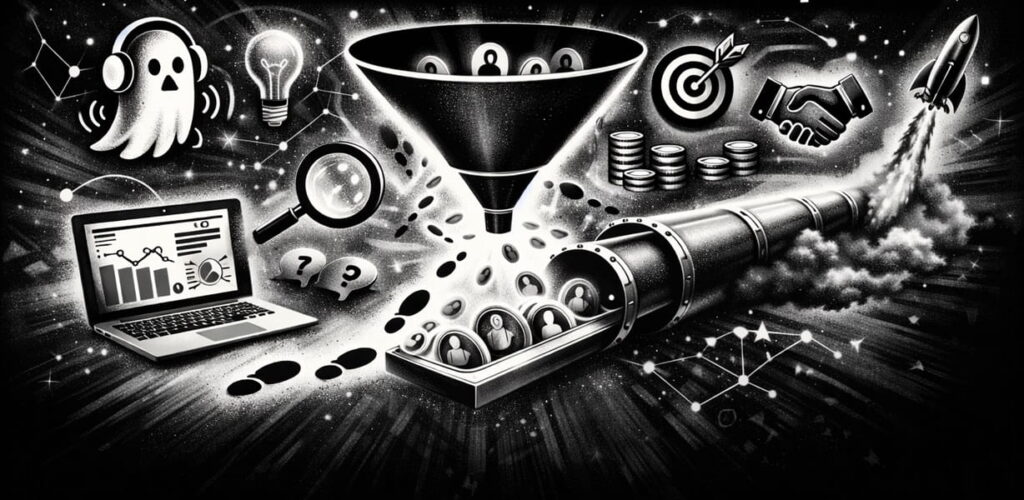
Tracking the dark funnel matters. But you also need to be present in it. Measurement alone won’t win deals that form in spaces you’re not participating in.
Create content that never asks anyone to click. The best dark funnel content gets screenshotted and pasted into a Slack channel. It becomes the thing someone references in a meeting without remembering where they saw it. Original research, counterintuitive frameworks, and genuinely useful data tend to travel. Generic thought leadership does not.
Show up where buyers talk to each other. That means Slack communities, LinkedIn comments, industry podcasts, and niche newsletters. Not as a brand shouting into the void, but as a company with a point of view worth engaging. The goal is to be the name someone drops when a colleague asks for a recommendation.
Own your review site presence. G2 and similar platforms are dark funnel channels you can actually influence. Systematically asking satisfied customers for reviews – and responding thoughtfully to both positive and negative ones – is one of the highest-leverage, lowest-cost dark funnel investments available. It now influences both direct buyer research and AI-generated vendor recommendations simultaneously. G2 currently serves over 90 million buyers annually, including employees at every Fortune 500 company. A sparse or outdated profile is actively costing you shortlist placement you can’t see.
Make your customers your best dark funnel asset. A customer who talks about you in a peer community, forwards your content internally, or names you on a podcast guest appearance is doing dark funnel work that no campaign can replicate. Building genuine customer advocacy – not referral schemes, but actual relationships – pays compounding returns across every channel you can’t measure.
Actionable Takeaways
- Add self-reported attribution to every high-intent form this week. Open-text field, not a dropdown. Ask how they first heard about you. Three months of responses will tell you more than your attribution platform ever has.
- Run a win/loss interview program – and treat it as a marketing function, not a sales one. Talk to five recent won deals and five lost deals. Ask specifically about pre-sales research. Where did they look? Who did they ask? What content circulated internally before anyone filled out a form?
- Correlate campaign activity to branded search volume, not just direct conversions. If you run a podcast tour and branded search climbs 18% in the following month, that’s a real signal. Stop requiring direct attribution for every brand-building investment.
- Audit your presence on G2, Capterra, and TrustRadius. These pages are being read by buyers and fed directly into AI recommendation engines. Outdated, sparse, or negative-heavy profiles are costing you shortlist placement in a channel you can’t recover from downstream.
- Accept that your attribution model will never be complete – and build your reporting accordingly. The present pipeline is influenced by dark funnel channels as a distinct metric in leadership conversations. The goal isn’t to tear down your current measurement stack. It’s to add qualitative intelligence that makes the quantitative data more honest.
As buyers increasingly adopt privacy controls, private collaboration spaces, AI research tools, and peer networks, the observable layer of buyer behaviour continues to thin – while real decision-making intensifies elsewhere. The CMOs who build strategies for where influence actually forms – not just where it’s measurable – are the ones whose pipelines hold up when the rest of the market starts wondering why their attribution looks fine, but their numbers don’t.
References
- 6sense 2025 Buyer Experience Report
- 6sense – Buyers Are Even Less of a Blank Slate Than We Thought
- 6sense – Buying Journey Theatre
- 6sense – How GenAI and LLMs Are Changing B2B Buyer Research
- 6sense 2025 Report Press Release – Business Wire
- RadiumOne Dark Social Research – MMA Global PDF
- Statista – Dark Social Sharing Data
- G2 2024 Buyer Behaviour Report – Business Wire
- G2 Marketing Solutions – Buyer Research Data
- MarTech – Dark Social Still Near 70 Per cent of Sharing Activity