Your marketing team is running campaigns, writing copy, pulling reports, scheduling posts, and answering customer queries. Most of that is work AI can now handle autonomously – not with a prompt, but on its own.
That’s the actual difference between AI agents and the ChatGPT tab you already have open. One waits. The other works.
In 2026, Gartner expects 40% of enterprise applications to ship with task-specific AI agents by the end of the year, up from less than 5% in 2025. Marketing is not on the sidelines of this. According to Salesforce State of Marketing 2026, 91% of marketing professionals now use AI tools in daily workflows, and 90% specifically use AI agents for decision-making.
This article is a practitioner’s guide – not a trend piece. By the time you finish reading, you’ll know what AI agents actually are, where they break down, which ones work for marketing teams right now, and how to start without rebuilding your entire stack.
If you’ve read our piece on how AI is reshaping SEO strategy, you already understand that AI isn’t just a content tool – it’s becoming the operating system of modern marketing. Agents are where that shift gets operational.
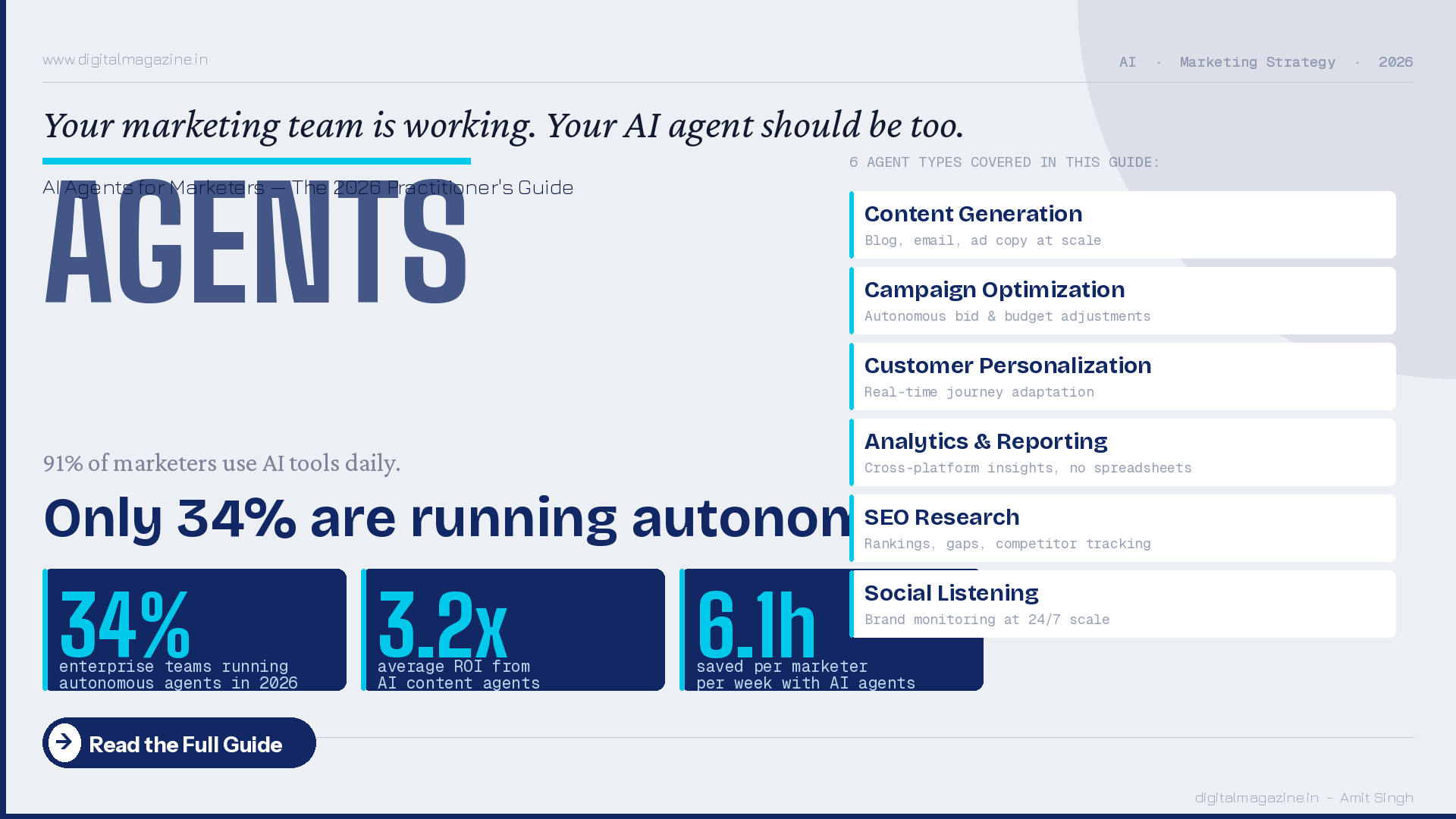
| 34% | Enterprise marketing teams running autonomous agents in 2026. Source: Salesforce State of Marketing 2026 / HubSpot AI Trends 2026 |
| 3.2x | Average ROI from AI content drafting agents. Source: McKinsey Global AI Survey 2026 |
| 6.1h | Saved per marketer per week with AI agents Source: HubSpot AI Trends 2026 |
What Is an AI Agent, Actually?
Most “AI” in marketing is reactive. You type a prompt, it responds. You upload a brief, it drafts copy. You ask a question, it gives an answer. That’s a tool. A useful one, but still fundamentally dumb about what to do next.
An AI agent is different in one specific way: it can perceive inputs, make decisions, and take action – without you initiating each step.
Here’s a simple example. A traditional AI tool can write an email subject line. An AI agent can monitor your email campaign’s open rate, notice it’s dropping, generate three subject line variants, A/B test them against your list, pick the winner, and update the next campaign send – all while you’re in a meeting.
The technical architecture behind most agents involves three components:
- Perception – the agent takes in data from connected tools (your CRM, ad platform, analytics dashboard)
- Reasoning – it applies a goal or rule to that data and decides what to do
- Action – it executes: sends, updates, pauses, adjusts, creates
What makes this different from traditional automation is the reasoning layer. Old automation follows rigid if-then rules. Agents interpret context and adapt. That’s what makes them genuinely useful – and occasionally unpredictable, which is why human oversight still matters.
For a deeper look at how AI systems process and synthesize information, our article on RAG and GEO covers the retrieval architecture that underpins most modern AI agent systems.
Why Marketers Need to Pay Attention Right Now
The market numbers are striking, though they vary significantly depending on how “AI agent” is defined. The global AI agents market was valued at $7.63 billion in 2025 and is projected to reach $182.97 billion by 2033, growing at a CAGR of 49.6%. More practically relevant for marketers: 34% of enterprise marketing teams now run at least one autonomous agent in production – more than double the 14% reported in Q4 2025.
That doubling in six months is the signal. This is not a technology being evaluated in labs anymore.
According to McKinsey Global AI Survey 2026, AI content drafting agents deliver 3.2x ROI on average, personalization engines deliver 2.7x, and audience research agents deliver 2.4x. These are self-reported figures from survey respondents, so take them as directional rather than precise – but the consistency across independent surveys is hard to ignore.
The productivity data is more concrete. HubSpot AI Trends 2026 reports marketers recover an average of 6.1 hours weekly using AI agents, with senior practitioners saving 8-10 hours and junior staff saving 3-4 hours.
There’s also a less comfortable data point worth acknowledging: 23% of agencies reduced junior copywriting headcount in 2025, and 31% plan further cuts in 2026, according to Gartner CMO Spend Survey. Agents aren’t just helping marketers – they’re displacing some marketing work. That’s a real shift, and pretending otherwise doesn’t help anyone plan for it.
The 6 Types of AI Agents Most Useful for Marketing Teams
Not all agents do the same thing. Here’s how they break down by function, with honest assessments of what works and what doesn’t yet.
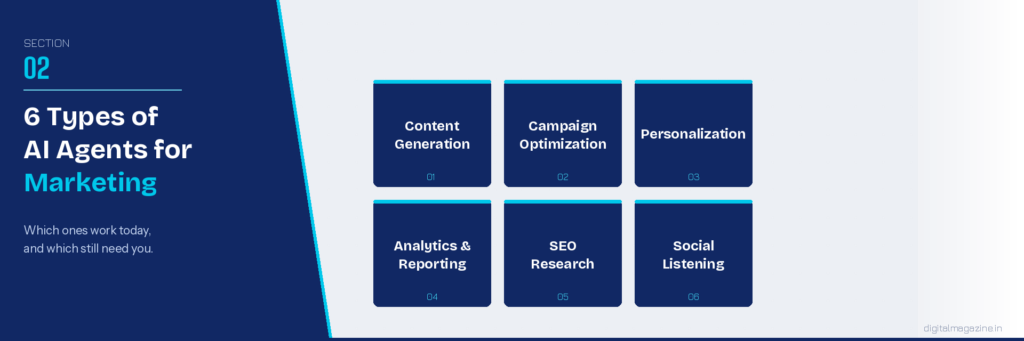
1. Content Generation Agents
These handle drafting across formats – blog posts, email copy, social captions, ad variations. The best ones don’t just produce text; they analyze which formats and topics are performing and adjust output accordingly.
- What works well: High-volume, structured content. Product descriptions, email sequences, ad variants, meta descriptions.
- What still needs humans: Brand voice, original reporting, opinion-led pieces, anything requiring genuine expertise.
Tools worth knowing: Jasper, Writer, HubSpot Breeze Content Agent.
2. Campaign Optimization Agents
These monitor live campaign performance and make adjustments – bid changes, audience targeting, budget reallocation – without waiting for your weekly review meeting.
- What works well: Paid search and paid social optimization. Google Ads and Meta both have native agent-like features (Performance Max, Advantage+).
- What still needs humans: Strategic direction, brand safety decisions, any campaign touching sensitive topics.
Marketing teams using AI-assisted decisioning report 25% faster campaign execution and 40% improvement in output quality compared to teams relying solely on manual analysis, according to G2’s AI Decision Intelligence in Marketing report.
3. Customer Journey Personalization Agents
These pull behavioral signals – page views, email opens, purchase history, support tickets – and dynamically adjust what a customer sees or receives next.
This connects directly to work we’ve covered before on AI-powered customer journey personalization. Agents are how that personalization actually gets operationalized at scale.
- What works well: Triggered email sequences, product recommendations, retargeting logic, on-site content personalization.
- What still needs humans: High-stakes customer communications, anything involving a complaint or sensitive situation.
4. Analytics and Reporting Agents
These pull data from multiple platforms, identify patterns, and generate reports – without anyone opening a spreadsheet.
Customer service conversations with AI agents grew at a compound monthly rate of 2,199% between January and June 2025, according to the Salesforce Agentic Enterprise Index.
Tools in this space: Improvado, Supermetrics with AI layers, Tableau Pulse.
5. SEO and Content Research Agents
These monitor rankings, identify content gaps, suggest updates to existing articles, and flag when competitor content is outperforming yours.
For site owners focused on organic growth, this connects to the measurement challenges we covered in our article on Share of Model and AI visibility tracking. Agents can monitor your brand’s presence in AI-generated search results – something standard analytics tools can’t do.
Tools worth knowing: Semrush’s AI toolkit, Ahrefs Brand Radar, Otterly.ai.
6. Social Listening and Brand Monitoring Agents
These track mentions, sentiment shifts, competitor activity, and trending topics across platforms – and can surface actionable alerts before a small issue becomes a PR problem.
- What works well: Monitoring at scale. No human team can read every mention across Twitter/X, Reddit, LinkedIn, and news simultaneously.
Tools: Brandwatch, Sprinklr, Mention.
How to Start: A Step-by-Step Implementation Guide
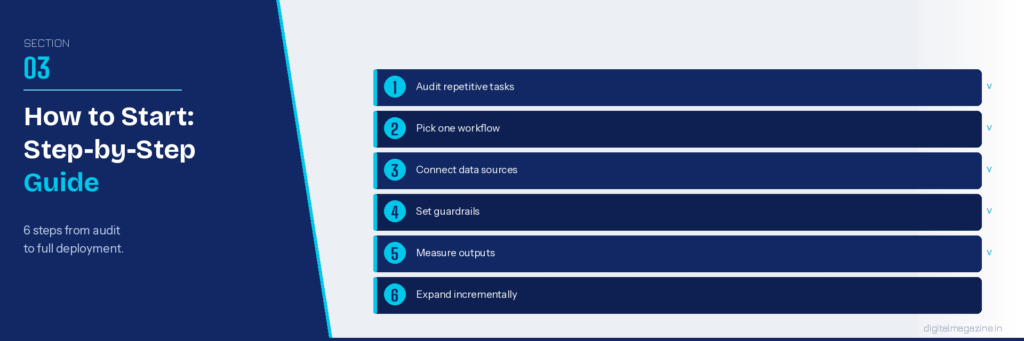
Most marketing teams that fail with AI agents do so not because the technology doesn’t work but because they start with the wrong use case or skip the infrastructure work that makes agents actually useful.
Step 1: Audit your repetitive tasks
Spend one week logging every marketing task that is repetitive, rule-based, or data-dependent. Report generation, social scheduling, campaign tagging, audience segmentation updates – these are your candidates. Don’t start with creative work.
Step 2: Pick one workflow, not one tool
Most agents are sold as platforms, but what you’re actually buying is a workflow. Choose a single, well-defined workflow – say, weekly performance reporting – and solve that problem completely before adding complexity.
Step 3: Connect your data sources
Agents are only as useful as the data they can access. Before deploying anything, audit your integrations: CRM, ad platforms, analytics, email platform. An agent that can’t read your CRM data can’t personalize anything meaningfully.
Step 4: Set guardrails before you set it free
Define what the agent can and cannot do autonomously. Can it adjust ad bids up to 20%? Can it pause a campaign? Can it send emails? Start narrow – the agent should surface recommendations for human review before you give it execution authority.
Step 5: Measure the right outputs
Don’t measure how much the agent does. Measure whether the outcomes improved. Open rates, conversion rates, time-to-publish, campaign ROI – these are the metrics that tell you whether the agent is actually helping.
Step 6: Expand incrementally
Once one workflow is running reliably, add adjacent ones. The goal is a connected system where agents share data – your content agent knows what your analytics agent found, and your campaign agent responds to what your SEO agent flagged.
5 AI Agent Tools Worth Evaluating in 2026
Salesforce Agentforce
Best for enterprise teams already on Salesforce. Deeply integrated with CRM data, runs autonomous agents across sales, service, and marketing. High capability, high complexity, high cost.
HubSpot Breeze
The most accessible entry point for mid-market teams. Breeze agents handle prospecting, content drafting, and customer data cleanup within HubSpot’s existing interface.
Adobe Experience Platform AI Assistant
Designed for personalization at scale across web, email, and mobile. Most powerful when you’re already in the Adobe ecosystem.
Writer
Purpose-built for brand governance and content at scale. Better for content operations than campaign management.
Jasper
Strong for content generation agents, particularly teams producing high volumes of marketing copy.
The honest assessment: none of these are plug-and-play. Every implementation requires data wiring, rules configuration, and an honest conversation about what humans still need to own.
What AI Agents Still Can’t Do
This section doesn’t get written enough in the coverage of AI agents, so it’s worth being direct.
They hallucinate. Agents that generate content or pull data can produce confident-sounding outputs that are wrong. According to McKinsey’s 2025 State of AI survey, while 88% of organizations use AI in at least one function, only 23% are scaling agentic systems – and the gap is largely explained by reliability and governance concerns.
They amplify bad data. An agent connected to a poorly maintained CRM will make personalization decisions based on wrong data. Garbage in, personalized garbage out.
They don’t understand context the way humans do. An agent might pause a campaign during a product launch because metrics look bad – missing that the dip is expected and intentional.
They change the team, not just the workload. Senior strategist demand climbed 18% in 2025 while junior roles fell, according to Gartner CMO Spend Survey. AI agents don’t eliminate the need for marketing talent – they shift what that talent needs to do.
Our article on the ethical implications of AI in marketing covers the governance questions in more depth – data consent, transparency, bias in automated decisions.
Recommended YouTube Resources
Before implementing, these two videos are worth your time:
“AI Agents, Everything You Need to Know To Get Started”
A January 2026 explainer covering what AI agents are, how they differ from chatbots, and where they’re already being deployed in business contexts.
“How I Run a Marketing Agency With 6 AI Agents”
A June 2026 walkthrough showing a real marketing agency’s agent setup – the actual tools, workflows, and where humans still own decisions.
Actionable Takeaways
- Start with reporting, not creation. Automating your weekly performance report is lower risk than automating content.
- Audit your data hygiene before deploying anything. Agents built on dirty data produce confidently wrong outputs.
- Define a human review step for any agent with execution authority. Anything that sends, publishes, or spends should surface for approval first.
- Track hours saved and outcome metrics separately. Hours saved is a vanity metric if campaign performance is flat.
- Prioritize connected agents over isolated ones. An analytics agent that talks to your content agent is far more useful than two disconnected tools.
- Don’t skip the governance conversation. Who owns the agent’s decisions? Establish this before deployment.
Frequently Asked Questions
What is the difference between an AI agent and an AI chatbot?
A chatbot responds to what you ask. An agent acts on what it perceives – monitoring data, making decisions, and executing tasks without a human prompt for each step.
Do I need a developer to use AI agents for marketing?
Not for most commercial platforms. HubSpot Breeze, Salesforce Agentforce, and Jasper are all designed for non-technical users.
What marketing tasks should I never fully automate?
Crisis communications, influencer relationships, customer complaints involving real emotional stakes, and decisions involving significant budget spend without a human in the loop.
How do I measure whether an AI agent is working?
Compare the business metrics (conversion rates, open rates, campaign ROI) before and after deployment. Also measure error rates – how often the agent’s outputs need human correction.
Are smaller marketing teams ready for AI agents?
Yes, but start simpler. A five-person team doesn’t need Salesforce Agentforce. HubSpot Breeze or a well-configured Zapier workflow with AI actions achieves most of what’s needed.
The Bottom Line
AI agents are not a future technology. 34% of enterprise marketing teams now run autonomous agents in production – double the figure from Q4 2025. The teams that understand how agents work, where they break, and how to direct them effectively will have a real operational advantage over teams still treating AI as a chat interface.
The competitive window isn’t infinite. Start with one workflow. Get it right. Then expand.
Related reading that may help you build the broader picture: