A WhatsApp marketing message to an Indian customer costs ₹0.8631 on Meta’s rate card. By the time it reaches your invoice, the same message can cost ₹1.29. Nobody lied to you along the way. You just met the three layers of WhatsApp pricing that most guides explain one at a time: Meta’s rate, your provider’s cut, and GST.
This guide puts all three in one place. It covers what every message category costs in India, what changed on October 1, 2026, and how to estimate your own bill. It also covers the problems teams actually run into and how to fix each one. It works whether you send 2,000 messages a month from a single shop or 20 million from a national brand.
Last updated: September 24, 2026. Meta can change WhatsApp rates only on the first day of a quarter (January 1, April 1, July 1 or October 1), per its published pricing calendar. This page is reviewed after each of those dates.
The Short Answer: India’s WhatsApp API Rates
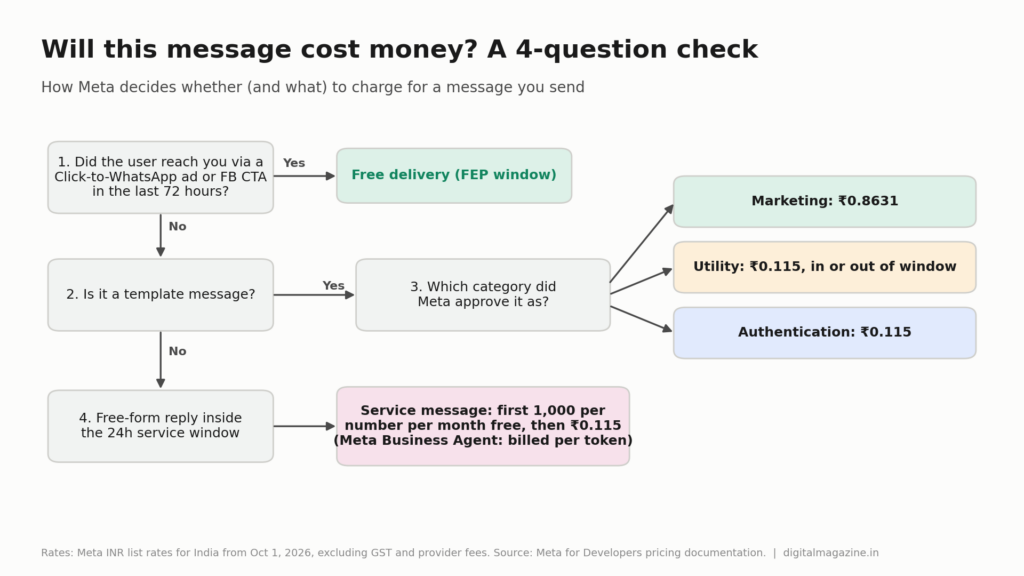
Meta charges for WhatsApp Business Platform messages per delivered message, not per conversation. The price depends on two things: the message category and the country code of the person receiving it. Your company’s location does not set the rate. The recipient’s number does.
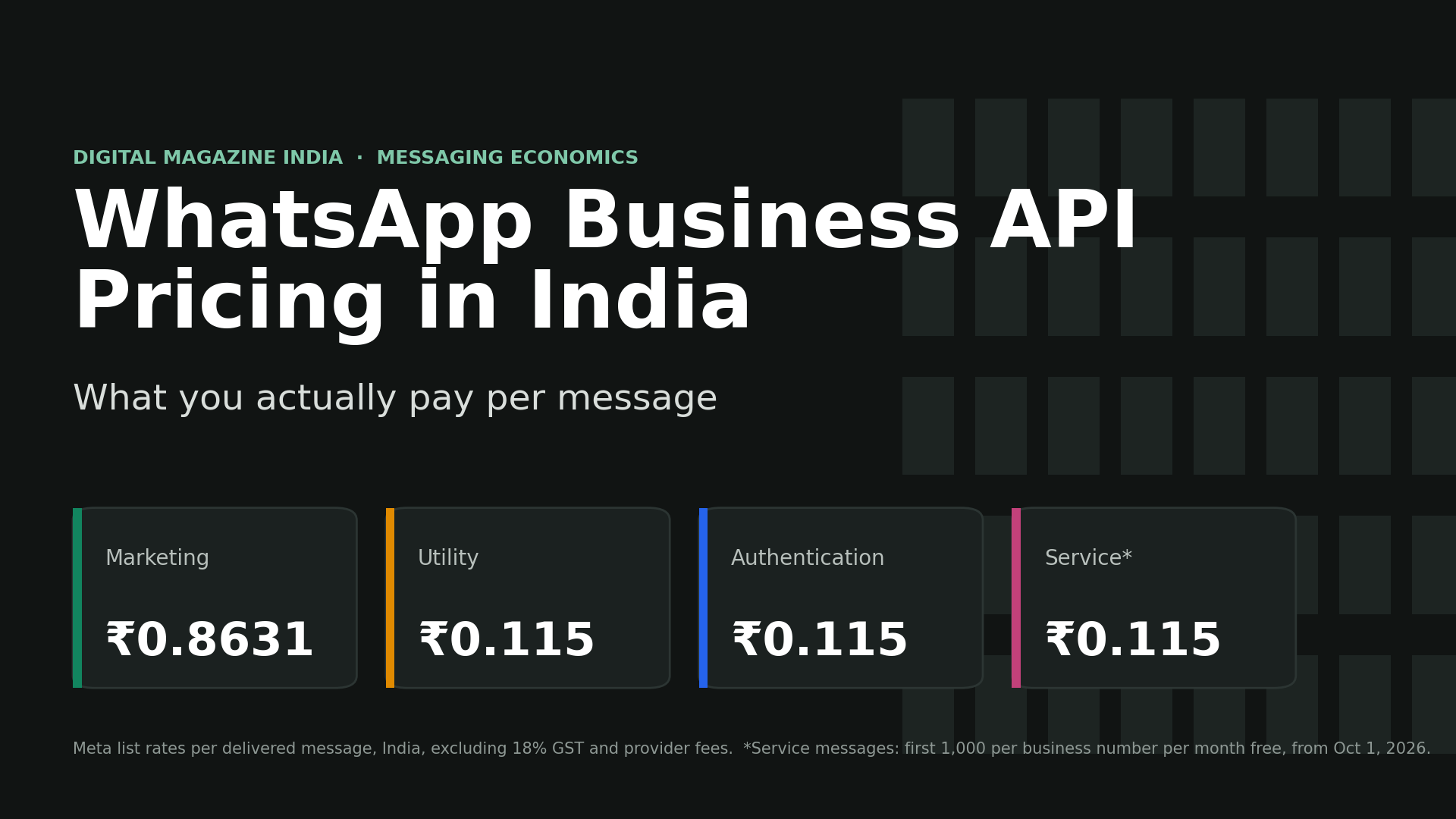
Here are the India list rates on the card that takes effect October 1, 2026, as reported by providers that track Meta’s INR rate card:
| Message category | Rate per delivered message (INR, before GST) | Typical use |
|---|---|---|
| Marketing | ₹0.8631 | Offers, launches, cart reminders, re-engagement |
| Utility | ₹0.115 | Order updates, payment reminders, account alerts |
| Authentication | ₹0.115 | One-time passwords (OTPs) |
| Service | ₹0.115 after 1,000 free per business number each month | Free-form replies to customers who messaged you |
| Authentication-international | ₹2.4971 | OTPs that fall under Meta’s authentication-international rules |
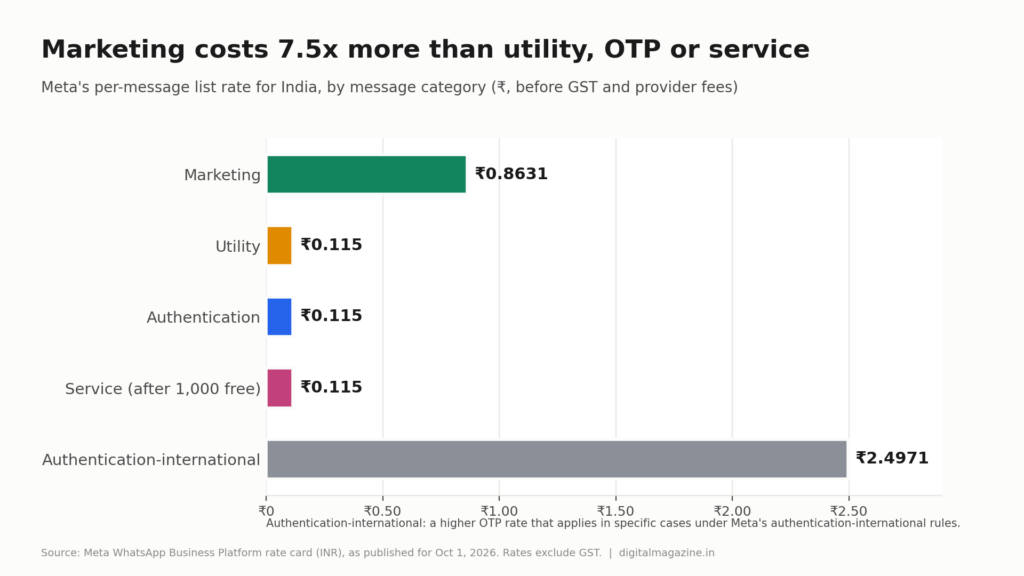
A marketing message costs about 7.5 times as much as a utility, authentication or service message. That single ratio drives most WhatsApp budgets in India. Two companies sending the same number of messages can have bills that differ by a factor of five, purely because of their category mix.
Always confirm the live figure on Meta’s own rate cards and volume tiers before you sign a budget. Meta publishes an INR card for India, and it is the only source that settles a dispute.
How WhatsApp API Billing Works in India
Per-message pricing replaced conversations
Until mid-2025, Meta billed for 24-hour “conversations,” and one fee covered every message inside that window. That model ended on July 1, 2025, when Meta switched to per-message pricing. Any guide still talking about “1,000 free conversations a month” describes a system that no longer exists.
Under the current model, Meta charges when a message is delivered, not when it is sent. Messages that fail to deliver cost nothing. If a marketing blast partly fails, you pay only for the share that landed.
The four message categories
Meta sorts every message into a category, and each category has its own price. The official template categorization guidelines define them like this:
- Marketing: Anything promotional or persuasive. This includes offers, new product alerts, abandoned cart reminders, renewal nudges and even birthday greetings. Meta also counts any template that mixes utility and promotion as marketing.
- Utility: Messages triggered by something the user did or asked for, such as an order confirmation, a shipping update or a payment reminder. A utility message must be non-promotional and specific to the user, or essential to them (a fraud alert, a recall).
- Authentication: One-time passcodes for login, sign-up or account recovery. These must use Meta’s authentication templates with a copy-code or one-tap button, and URLs, media and emojis are not allowed.
- Service: Free-form replies you send inside an open 24-hour customer service window. The window opens, and resets, each time a customer messages you.
One detail catches many teams out. Meta lists “your subscription will expire, renew today to save 10%” as a marketing example, not utility. Anything that tries to win a sale or a renewal is marketing, even when the customer asked for it.
The 24-hour customer service window
When a customer messages your business, a 24-hour window opens. Inside it, you can reply with free-form messages (text, images, documents) without using a pre-approved template. Outside it, you can only reach the customer with an approved template.
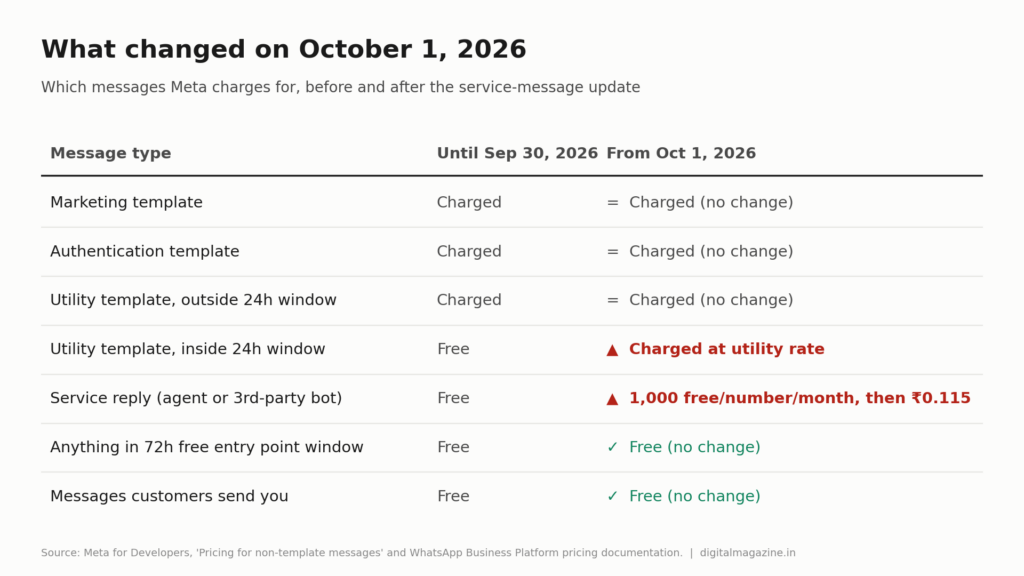
For a long stretch, that window was also a cost shield. Service replies inside it were free from November 2024, and utility templates sent inside it were free from July 2025. That shield changed on October 1, 2026, which the next section covers in detail.
The 72-hour free entry point window
There is still one genuinely free lane. It starts when someone messages you from a Click-to-WhatsApp ad or a Facebook Page call-to-action button on the mobile app. Reply within 24 hours and a 72-hour free entry point window opens, during which every message you deliver is free, templates included.
Meta confirmed in its non-template pricing notes that this 72-hour window stays free for message delivery after the October 2026 change. The one exception is Meta’s own AI agent, which is still billed for the tokens it uses. For businesses that already run paid social, this window is now the biggest cost lever left.
What Changed on October 1, 2026
Meta announced two linked changes that take effect on October 1, 2026. Both are documented on Meta’s pricing page for non-template messages.
- Service messages are now billable. Free-form replies sent by a person or by a third-party AI tool cost the same as a utility or authentication message in that market. In India, that is ₹0.115 each.
- Utility templates inside the service window are billable again. They had been free inside the window since July 1, 2025. They now cost the normal utility rate wherever they land.
To soften the change, Meta added a free tier of 1,000 delivered service messages per business phone number per month. The allowance resets each month and does not roll over, as 360dialog’s breakdown of Meta’s documentation explains. Service messages also get no volume discounts, unlike utility and authentication.
The Meta Business Agent is priced differently
On August 1, 2026, Meta started charging for replies from its own AI agent, the Meta Business Agent. It bills per token rather than per message, at US$2.00 per million tokens. Meta says a typical message uses about 20,000 to 25,000 tokens, which works out to roughly 4 to 5 US cents per message.
A reply is charged either as a service message or as a Meta Business Agent message, never both. Meta’s own worked example shows a single customer journey going from one charge to five charges once both changes are live. If your support runs on WhatsApp, re-run your cost model before your October invoice arrives rather than after. For a broader view of where AI agents fit in a marketing team, see our guide to AI agents for marketers.
Payment method deadline
Meta stated that any provider or directly integrated business without a payment method on file by September 30, 2026 would have service message delivery stopped once charging begins. If your support replies suddenly stop delivering in October, check this first.
The Real Cost Stack: Why Your Invoice Is Higher
Meta’s rate is only the first layer of your bill. Most Indian businesses reach the WhatsApp Business Platform through a Business Solution Provider (BSP), and the final price has three parts.
Layer 1: Meta’s per-message rate
This is the table above, charged per delivered message. It is identical whichever provider you use. No BSP can sell you a cheaper Meta rate, although some can help you qualify for volume tiers faster.
Layer 2: Provider fees and markups
BSPs make money in two ways: a platform subscription, and often a markup on each message. AiSensy, for example, publishes ₹1.09 per India marketing message and ₹0.145 per utility message. Against Meta’s rates, that is a markup of roughly 26% on both categories.
Markups are not automatically bad. You might be paying for a better campaign builder, a shared inbox, Shopify integration or faster support. The problem is when the markup is buried and you cannot compare quotes on equal terms.
Layer 3: GST
Indian providers state that 18% GST applies on top of Meta’s per-message rates and on BSP fees. A ₹0.8631 marketing message becomes about ₹1.0185 once GST is added, before any markup. Registered businesses on the regular GST scheme may be able to claim input tax credit. Confirm the treatment for your setup with your chartered accountant, because it depends on how your provider invoices you.
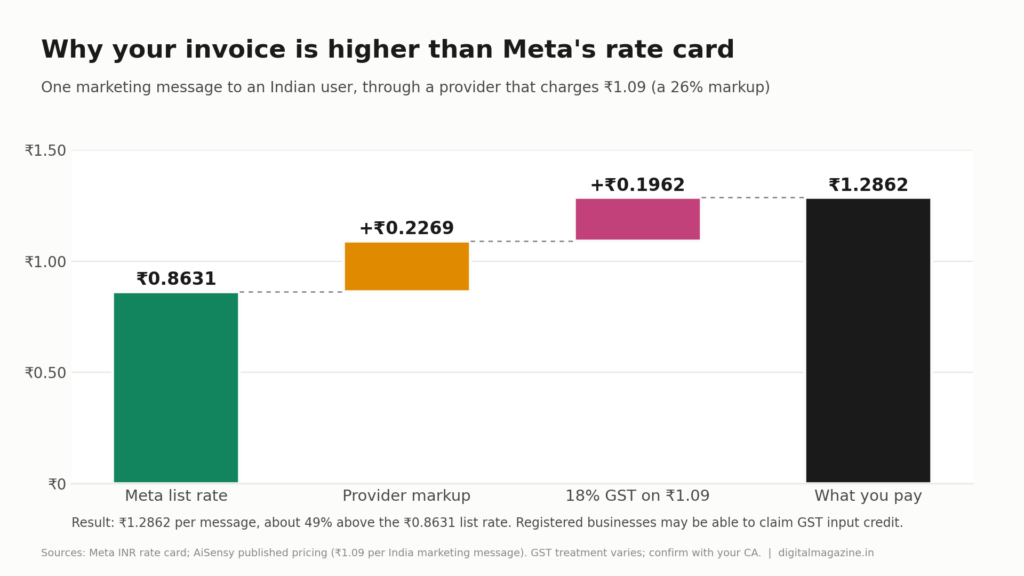
Put together, a marketing message through a provider charging ₹1.09 costs about ₹1.2862 including GST. That is roughly 49% above the Meta list rate most people quote. Each layer is disclosed somewhere. They are just rarely shown together.
How to Estimate Your Monthly WhatsApp Bill
You can build a reliable estimate with a spreadsheet and five numbers. Use this formula for Meta’s charges:
Monthly Meta cost = (marketing messages x ₹0.8631) + (utility messages x ₹0.115) + (authentication messages x ₹0.115) + ((service messages – 1,000 per number) x ₹0.115)
Then add your provider’s markup and platform fee, and apply 18% GST to the total. If you run on more than one business phone number, each number gets its own 1,000 free service messages.
Worked examples
The volumes below are illustrative, not benchmarks. The rates are Meta’s India list rates, before GST and provider fees.
| Business type | Monthly volume | Meta charges | With 18% GST |
|---|---|---|---|
| Solo founder or small shop (1 number) | 2,000 marketing, 3,000 utility, 1,500 service | ₹2,129 | ₹2,512 |
| Mid-size D2C brand (1 number) | 50,000 marketing, 80,000 utility, 20,000 OTP, 30,000 service | ₹57,990 | ₹68,428 |
| Enterprise (5 numbers) | 1M marketing, 3M utility, 5M OTP, 400,000 service | ₹18.29 lakh | ₹21.58 lakh |
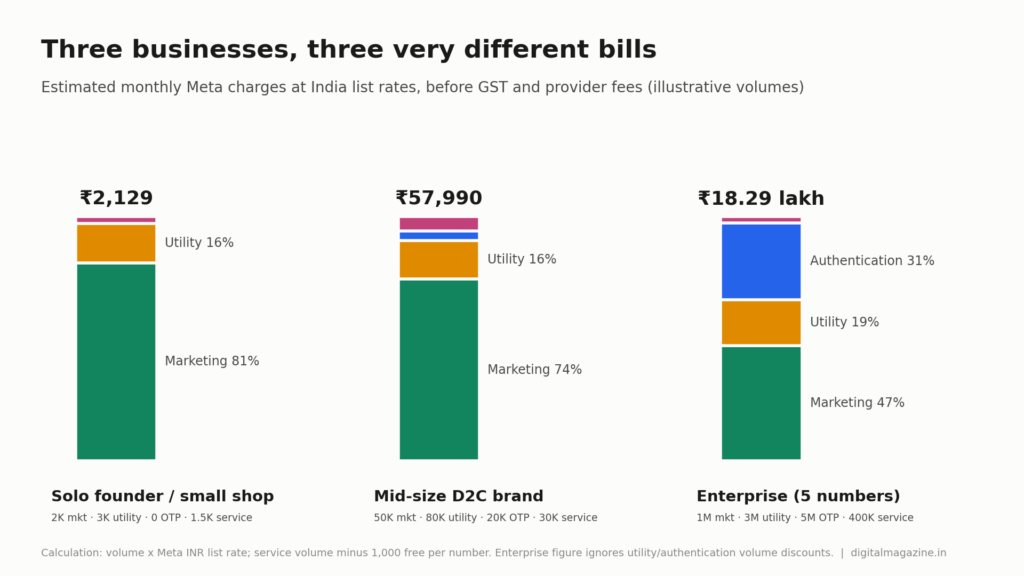
For smaller senders, marketing makes up roughly three quarters of the bill or more, even when it is a minority of messages. For the enterprise example, authentication becomes a big line item simply because of OTP volume. That is exactly where volume tiers start to matter, and the enterprise figure above ignores them.
What It Costs for Your Business Size
Single users, freelancers and very small shops
If you are a consultant, a home baker or a single-location store, start by asking whether you need the API at all. The free WhatsApp Business app covers one-to-one chats, a catalogue, quick replies and labels without per-message fees. The API makes sense once you need automation, several team members on one number, CRM integration or bulk campaigns to opted-in lists.
If you do move to the API, expect a small bill. The 1,000 free service replies a month cover many micro businesses entirely, so the provider’s platform fee is usually the biggest cost. Compare that fee carefully before you pick a provider.
Our guide to strategic digital marketing on a budget covers how to weigh tools like this against the rest of a lean marketing plan.
Small and mid-size businesses
This is where category discipline pays off fastest. A D2C brand sending 50,000 marketing messages a month spends about ₹43,000 on those alone, before GST. Moving 20% of that volume to better-targeted segments saves more than switching providers usually does.
At this size, also watch the markup. A 20-26% markup on 50,000 marketing messages adds roughly ₹8,600 to ₹11,200 a month. That is worth a negotiation, or at least a side-by-side quote with a provider that passes Meta’s rate through at cost.
Enterprises and high-volume senders
Large senders have three extra levers:
- Volume tiers. Utility and authentication rates fall as monthly volume grows. Providers report discounts of up to 30% off list at the highest tiers. Tiers are counted across all WhatsApp Business Accounts in your business portfolio, per Meta’s volume tier rules. Marketing and service messages get no tier discounts.
- Max-price bidding. Businesses on Meta’s Marketing Messages API for WhatsApp can now set a maximum price per marketing message, and Meta charges that price or less.
- Reporting at source. Meta’s Pricing Analytics API breaks down delivered messages and costs by category, and webhooks flag when you reach a new volume tier. Reconcile your provider’s invoice against this data every month.
Enterprises also carry the heaviest compliance load. India’s DPDP Rules require specific, provable consent for marketing messages, with full obligations in force from 13 May 2027. Your consent records and your WhatsApp marketing volume need to live in the same system of record. We cover the privacy side in more depth in ethical AI and data privacy in marketing.
Messaging Limits: The Cost Nobody Budgets For
Price is not the only constraint. Meta caps how many unique customers you can message outside a service window in any rolling 24-hour period. Per Meta’s messaging limits documentation, the ladder looks like this:
- 250 unique users a day for a new business portfolio
- 2,000 after you verify your business, or after sending 2,000 high-quality messages in 30 days
- 10,000, then 100,000, then unlimited, through automatic scaling
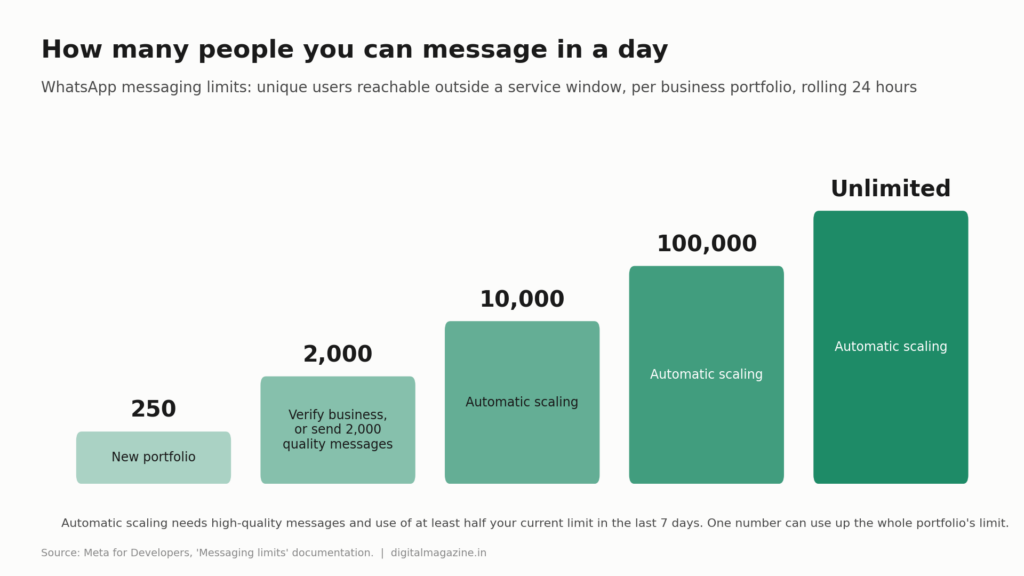
Automatic scaling needs two things: high message quality, and use of at least half your current limit in the past seven days. The limit is set at the business portfolio level and shared by every number in it. One busy number can use up the whole portfolio’s capacity for the day.
The practical lesson is to plan your launch. A brand that wants to message 40,000 people on day one cannot do it from a new, unverified account. Verify the business early and ramp volume over a few weeks.
Is WhatsApp Worth It Compared With SMS?
On price per message, WhatsApp marketing is not the cheap option. Plain SMS in India generally runs ₹0.10 to ₹0.20 per message depending on type and volume. A WhatsApp marketing message, at ₹0.8631 before GST, costs several times more. Utility and OTP messages on WhatsApp sit closer to SMS pricing.
Cost per outcome is the fairer comparison. Tata CLiQ reported a 57% click-through rate on WhatsApp and US$500,000 in sales in one month attributed to the channel. It also reported 10x the ROI of email, in-app push and SMS. Meta publishes these as self-reported results that will vary by business, so treat them as proof of what is possible, not as a forecast.
Independent benchmarks are more modest and more useful. Chatarmin, a WhatsApp marketing platform, published data from 382 e-commerce brands and 49.3 million campaign messages. It measured a 79.0% open rate on delivered messages, an 11.8% click rate and a 0.37% opt-out rate per message. Those brands sell mostly in Germany, Austria and Switzerland, so Indian results will differ.
Chatarmin also says the widely repeated “98% open rate” has no credible source. Treat it with suspicion when it shows up in a vendor deck.
The sensible answer for most Indian businesses is to use channels by job:
- SMS for universal reach and time-critical alerts to any phone
- WhatsApp utility and authentication for transactional messages where read rates matter
- WhatsApp marketing for your best, opted-in segments, not your entire database
- Email for long-form content and low-cost nurture
If you are building this as one connected journey, our guide to omnichannel content strategy shows how the channels hand off to each other.
Real-World Challenges and How to Solve Them
Reading the rate card is the easy part. Here are the problems that come up once a WhatsApp program is live, with the fix for each.
Editor’s note for Amit: add one or two short examples from your own CPaaS vendor work here (anonymised), for example a markup you negotiated down or a recategorization you caught. First-hand detail is what search engines and AI answers reward most, and it cannot be copied by competitors.
1. The invoice is much higher than the quote
What happens: A team budgets at ₹0.86 per marketing message and receives an invoice closer to ₹1.29.
Why: The quote showed Meta’s rate. The invoice added a provider markup and 18% GST, as shown in the cost stack above.
How to fix it:
- Ask every provider for an all-in price per delivered message, by category, in writing
- Ask whether Meta’s charges appear as a separate line item or are bundled into the markup
- Compare quotes on total monthly cost at your real volume, not the platform fee alone
2. Utility templates get reclassified as marketing
What happens: Order updates that used to cost ₹0.115 start billing at ₹0.8631.
Why: Since April 2025, Meta approves a template as marketing if it decides a template submitted as utility is actually promotional. It also runs recurring checks on templates already in use. An order confirmation with “you might also like” or a discount code is marketing by Meta’s definition.
How to fix it:
- Keep transactional templates free of offers, cross-sells and persuasive language
- Send the promotion as a separate, deliberate marketing template to opted-in users
- Watch the category update emails and webhooks. You can request a review within 60 days if you believe Meta got it wrong.
Repeated misclassification carries penalties. Meta can escalate from a warning to rate-limiting utility messages, to switching every utility template on the account to marketing for 7 to 30 days.
3. Marketing messages fail with error 131049
What happens: A campaign shows a slice of failed messages with error code 131049, “not delivered to maintain healthy ecosystem engagement.”
Why: Meta limits how many marketing templates any one person receives from all businesses combined. Meta does not publish a fixed number; its documentation, quoted by 360dialog, says the limit adapts to each person’s recent engagement. Some providers estimate it at around two a day, but that is their observation, not Meta’s rule. Utility, authentication and messages inside an open service window are not affected.
How to fix it:
- Do not retry straight away. Meta advises waiting at least 24 hours.
- Send fewer, better-targeted marketing messages to people who engage
- Use utility messages for genuinely transactional updates so they are not caught by the cap
The upside is that undelivered messages are not charged. The cost is lost reach, not wasted money.
4. Support costs jump after October 2026
What happens: A support team that ran thousands of free WhatsApp replies a month starts seeing a new line on its bill.
Why: Service replies became billable on October 1, 2026, after the first 1,000 per number each month.
How to fix it:
- Pull your current monthly service volume per number and model it at ₹0.115 per reply
- Design bots and agents to resolve issues in fewer messages, using buttons, lists and WhatsApp Flows instead of long back-and-forth
- Compare the per-reply cost of your third-party AI tool plus delivery with Meta’s Business Agent. Meta’s own comparison table shows either can win, depending on how complex the queries are.
Retail brands already running conversational commerce will feel this most. Our piece on real-time intent mapping and mobile AI chatbots covers how to design those journeys well.
5. The INR billing deadline
What happens: An Indian business still billed in US dollars finds its WhatsApp messages stop delivering in January 2027.
Why: Meta launched INR billing for India on January 1, 2026 for eligible customers whose Sold-To country is India. Eligible customers must migrate every WhatsApp Business Account to INR by December 31, 2026. From January 1, 2027, Meta will stop delivering messages from non-INR accounts of eligible customers.
How to fix it:
- Ask your provider today which currency each of your WhatsApp Business Accounts bills in
- Use Meta’s WABA Currency Migration APIs, available since June 1, 2026, which clone an account into a new one with a different currency
- Plan the switch outside your peak season, and re-check templates after migration
6. OTPs cost far more than expected
What happens: A fintech or app sees authentication charges at ₹2.4971 per OTP instead of ₹0.115.
Why: India has a separate authentication-international rate, roughly 22 times the domestic authentication rate. Whautomate reports that it hits businesses sending OTPs to Indian users from WhatsApp Business Accounts registered outside India.
How to fix it:
- Check which rate your authentication messages bill at in your pricing analytics
- Read Meta’s authentication-international rules for your exact setup
- If the rule applies, route Indian OTP traffic through an account that qualifies for the domestic rate
7. The launch stalls at 250 messages a day
What happens: A new account cannot reach its full customer list, and messages beyond the cap never go out.
Why: New business portfolios start at a messaging limit of 250 unique users per day.
How to fix it:
- Complete Meta business verification before launch day
- Ramp volume over two to four weeks with high-quality, opted-in sends
- Keep quality high, since automatic scaling depends on it
8. Consent gaps create legal risk
What happens: A team uploads its entire customer database, including people who only ever asked a support question, and runs a promotional campaign.
Why: Meta requires an opt-in before you message someone. India’s DPDP framework goes further: consent for marketing must be specific and informed. Under Section 6(4) of the DPDP Act, withdrawing consent must be as easy as giving it.
How to fix it:
- Keep marketing consent separate from transactional consent, and store when and how you got it
- Honour “STOP” and similar replies automatically, across every channel
- Treat your opted-in WhatsApp list as first-party data, as our first-party data strategy guide explains
Nine Ways to Lower Your WhatsApp API Costs
- Fix your category mix first. Every message you can honestly move from marketing to utility cuts its cost by about 87%. Only move messages that are truly transactional, or Meta will move them back.
- Segment before you send. Sending marketing messages to your most engaged customers costs less and reduces 131049 failures.
- Use Click-to-WhatsApp ads. The 72-hour free entry point window makes every follow-up in that period free to deliver.
- Shorten support conversations. After October 2026, each extra reply past the free 1,000 costs ₹0.115. Buttons and structured flows cut message counts.
- Qualify for volume tiers. Consolidate utility and authentication traffic under one business portfolio so all of it counts toward the same tier.
- Negotiate the markup, not just the platform fee. At high volume, a few percentage points of markup outweigh the subscription.
- Audit templates quarterly. Look for recategorized templates and anything a promotion has crept into.
- Reconcile invoices against Meta’s data. Use pricing analytics to confirm what was delivered and in which category before you pay.
- Measure revenue per message, not open rate. A cheap message that sells nothing is the most expensive one you send. Our guide to essential analytics metrics covers how to build that measurement, and our dark funnel guide explains why chat-driven sales often go under-attributed.
Videos Worth Watching
These free videos explain WhatsApp pricing visually. They are made by third parties, and older videos may not reflect the October 2026 change, so check the upload date against the timeline in this guide.
- WhatsApp Service Messages Are No Longer Free! Meta’s Major Pricing Update: covers the August and October 2026 changes
- WhatsApp Business API Pricing 2026 Explained (Simple Breakdown): a visual primer on per-message billing (published November 2025, before the service-message change)
- WhatsApp API Pricing Explained 2026 (Marketing, Utility & Authentication): covers which categories are free and which are paid (published January 2026)
- WhatsApp Business Summit India 2024 sessions: Meta’s own on-demand keynote and case studies from Indian businesses
Frequently Asked Questions
Is the WhatsApp Business API free in India?
No. Meta charges no setup or licence fee, but it charges for every delivered marketing, utility and authentication message. From October 1, 2026, it also charges for service replies beyond 1,000 per business number each month. Messages customers send you remain free, and so do messages delivered inside a 72-hour free entry point window.
How much does one WhatsApp marketing message cost in India?
Meta’s list rate is ₹0.8631 per delivered marketing message, before GST. With 18% GST, that is about ₹1.02. Provider markups can add more, so ask for an all-in price.
Are WhatsApp service messages free?
Not fully, from October 1, 2026. Each business phone number gets 1,000 free service messages per month, and each one after that costs the same as a utility message, which is ₹0.115 in India. Before that date, service replies were free with no cap.
Does GST apply to WhatsApp API charges in India?
Indian providers state that 18% GST applies to both Meta’s charges and provider fees. Registered businesses may be able to claim input tax credit. Confirm the treatment with your accountant, since it depends on how you are invoiced.
Do I pay for messages that fail to deliver?
No. Meta charges only for delivered messages. Messages blocked by per-user marketing limits (error 131049) are not charged.
Can I choose which currency I pay in?
Eligible Indian businesses now bill in INR. They must migrate all WhatsApp Business Accounts to INR by December 31, 2026, or Meta will stop delivering their messages from January 1, 2027.
Is WhatsApp cheaper than SMS in India?
For marketing messages, no. WhatsApp marketing messages cost several times more than plain SMS. For utility and OTP messages the gap is small, and many businesses find WhatsApp’s higher engagement worth it. Compare cost per conversion rather than cost per message.
How often do WhatsApp prices change?
Meta can update rates on the first day of each quarter: January 1, April 1, July 1 and October 1. It gives at least one month’s notice for rate changes, three months for new pricing add-ons, and six months for changes to the pricing model itself.
Actionable Takeaways
- Budget with three layers: Meta’s rate, your provider’s markup, and 18% GST. Quote the all-in number, not the list rate.
- Guard your category mix: marketing costs about 7.5 times as much as utility, and Meta will reclassify promotional “utility” templates.
- Re-model support costs now: service replies beyond 1,000 per number per month are billable from October 1, 2026.
- Check your billing currency: migrate every WhatsApp Business Account to INR before December 31, 2026.
- Use the free lane: Click-to-WhatsApp ads open a 72-hour window of free message delivery.
- Plan launches around messaging limits: verify your business early and ramp volume over weeks, not days.
- Build on consent: keep provable, separate marketing consent ahead of the DPDP deadline in May 2027.
- Verify before you budget: confirm current rates on Meta’s official rate card each quarter.
Sources
- Meta for Developers: Pricing on the WhatsApp Business Platform
- Meta for Developers: Pricing for non-template messages
- Meta for Developers: Template categorization
- Meta for Developers: Messaging limits
- Meta for Developers: WhatsApp changelog
- WhatsApp Business: Business Platform pricing
- WhatsApp Business: Tata CLiQ success story
- Whautomate: WhatsApp API pricing India rate card
- ChatMaxima: WhatsApp API pricing in India
- AiSensy: Pricing
- 360dialog: Service message charging starts October 1, 2026 and API error message list
- Wati: WhatsApp error 131049
- Chatarmin: WhatsApp statistics and benchmarks
- LeadNXT: RCS business messaging pricing in India
- ProtectComply: DPDP Rules 2025 timeline
- ComplyZero: How DPDP affects WhatsApp Business
Disclaimer: Rates and rules in this guide come from Meta’s documentation and published provider rate cards as of September 24, 2026. This is general information, not tax or legal advice.