A first-party data strategy is the most urgent rebuild on any CMO’s agenda right now. Here’s a number that should make any CMO sit up straight: only 25% of advertisers are completely prepared for the cookieless transition, according to a YouGov study commissioned by Taboola in May 2024. Meanwhile, 48% of global web traffic is already cookie-less today, pushed there by Safari, Firefox, and mobile privacy enforcement that didn’t wait for anyone to be ready.
Read those two numbers together, and you get the actual state of B2B marketing in 2026: nearly half the web is operating without the tracking infrastructure most teams were built on, and the majority of marketing leaders haven’t finished rebuilding.
That gap – between where the web already is and where most stacks actually operate – is where budget is bleeding silently. Not in ways that show up as a red line on a dashboard. In ways that show up six months later when pipeline drops, and nobody can explain why the channels that looked fine stopped performing.
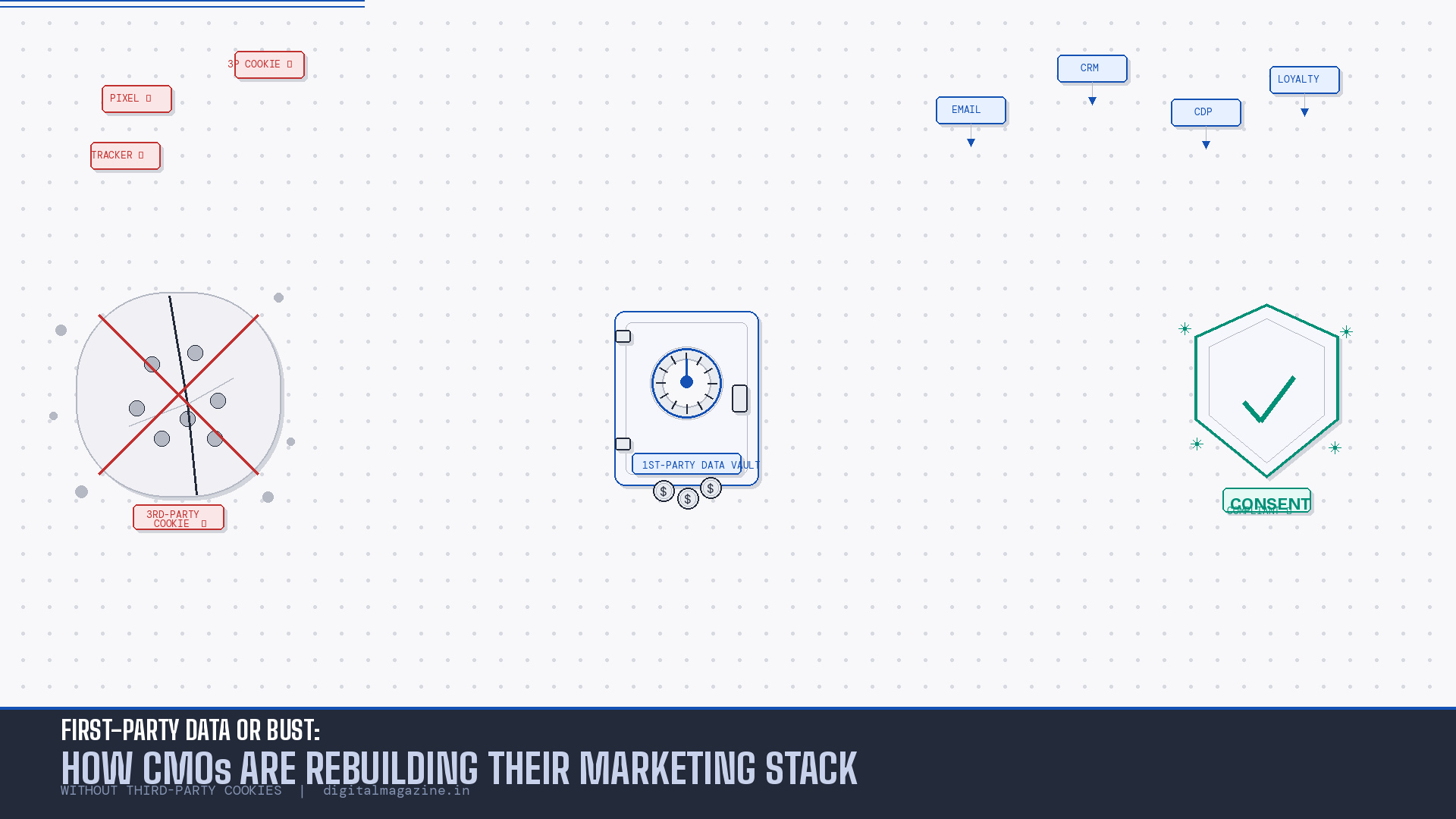
This isn’t a cookie deprecation problem. The cookie is already gone in most places. This is a data ownership problem – and fixing it starts with understanding exactly what you’re rebuilding and why.
The Cookie Isn’t Just Dying – It’s Already Gone in Most Places
Google gets most of the press around cookie deprecation, so it’s easy to assume this is a future problem. It isn’t.
Safari has blocked third-party cookies since 2017 through Intelligent Tracking Prevention (ITP). Firefox followed with Enhanced Tracking Protection. Between those two browsers alone, a massive share of web traffic has been cookie-free for years. 48% of global web traffic is already cookieless – that’s not a projection. That’s today.
Google’s Privacy Sandbox adds complexity rather than clarity. Only 14% of large advertisers see it as a complete replacement for third-party cookie targeting. The rest are patching, waiting, or quietly building something different.
The regulatory layer compounds the technical one. GDPR cumulative fines now exceed €7.1 billion, with €1.2 billion levied in 2025 alone, as European regulators continue to escalate enforcement. The primary source is DLA Piper’s annual GDPR Fines and Data Breach Survey, which confirmed the 2024 annual total. California’s CCPA ended its 30-day cure period on December 31, 2024 – violations now result in immediate penalties. More than 19 US states had enacted comprehensive data privacy laws by January 2026. This is no longer a San Francisco or Brussels problem.
Browser privacy settings, ad blockers, and ITP are now deleting even first-party cookies in as little as 24 hours in some environments. Client-side tracking – the kind most analytics stacks run on – is structurally unreliable even when it’s technically legal.
The CMOs who treat this as a future problem to solve after the next planning cycle are already behind.
Why Most Marketing Stacks Are Flying Blind Right Now
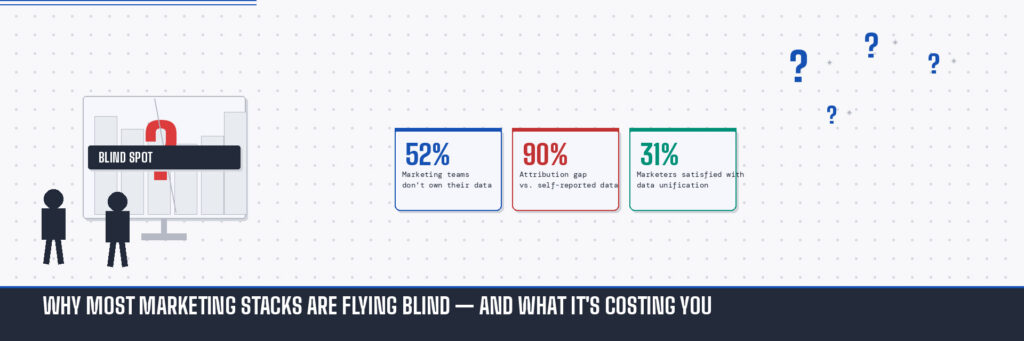
The readiness gap isn’t just a technology gap. It’s a data ownership gap. The numbers around it are stark.
52% of marketing teams don’t actually own their customer data. It lives in platforms – Meta, Google, LinkedIn – that control access, change terms, and can revoke it. Teams mistake platform audience data for owned data, which creates a false sense of security until the platform changes its API or its pricing.
Only 31% of marketers are fully satisfied with their ability to unify customer data across sources, according to Salesforce’s State of Marketing, 9th Edition. That means nearly 70% of marketing organisations are making budget and targeting decisions based on a fragmented, incomplete picture of their customers – even before you factor in tracking loss.
The downstream effects are real. When tracking breaks, campaign measurement gaps appear. Customer acquisition costs inflate because you can’t suppress existing customers from acquisition campaigns. Attribution becomes unreliable, and CMOs start defunding channels that look like they don’t work – when what they actually don’t do is show up in a broken reporting stack.
This compounds the dark funnel problem directly. If you’ve read our piece on Dark Funnel Decoded: How to Track the Buyer Journey You Can’t See, you already know that most of the B2B buying journey happens in spaces your attribution model can’t see. Cookie loss makes the visible portion even smaller. The two problems feed each other.
What First-Party Data Actually Means (And What It Doesn’t)
This is where most articles skip a step that matters, so let’s be precise.
First-party data is information you collect directly from your own audience through direct interactions – with their knowledge and consent. It includes: email addresses collected through opt-in forms, on-site behavioural data (pages visited, content downloaded, time spent), CRM records from direct customer relationships, purchase and transaction history, loyalty program activity, customer service interactions, and app usage data.
Zero-party data is a subset that’s even more valuable: information customers proactively and explicitly volunteer. Preference centre responses, quiz results, survey answers, product configurator inputs. No inference required. No tracking pixel needed.
What does not count as first-party data: audience segments purchased from data brokers, behavioural data inferred from third-party pixels firing on your site, and lookalike audiences modelled from platform data you don’t own.
The practical distinction matters because it determines what’s legally defensible, what persists across platform changes, and what you can actually activate across your stack without dependency on someone else’s infrastructure.
Consent isn’t just a legal checkbox in this framework. It’s a data quality filter. Data people actively chose to share with you is more accurate, more durable, and more actionable than data inferred from behavioural tracking. 80% of consumers are more likely to purchase from brands that offer personalised experiences – and personalisation built on consented first-party data is the only kind that scales as privacy regulation tightens.
The Revenue Case Is Clearer Than You’d Expect
Before getting into the infrastructure rebuild, the ROI case for first-party data is worth stating plainly.
Organisations with mature first-party data programs achieve 2.9x higher revenue growth than those relying primarily on third-party sources, according to research by Google and BCG. That’s not 29% better. That’s nearly triple.
First-party data improves customer acquisition costs by up to 83% and conversions by 73%, per Forrester Consulting’s 2024 behavioural data impact study. The CAC improvement alone changes the unit economics of most paid media programs substantially.
At the campaign execution level, the CDP case study data is consistent: brands using first-party data for marketing through a CDP achieve 2.9x revenue lift and a 1.5x increase in cost savings, according to McKinsey research. A concrete example: fashion brand NA-KD deployed a CDP-powered first-party data strategy and saw a 25% uplift in customer lifetime value and a 72x return on investment within 12 months.
The mechanism behind these numbers isn’t complicated. When you know who your customers are, you stop wasting acquisition budget re-acquiring them. You stop showing the wrong message to the wrong person at the wrong stage. And you start building targeting that’s based on what people actually did, not on what a probabilistic model guesses they might do.
The Four Pillars of a First-Party Data Strategy That Actually Works
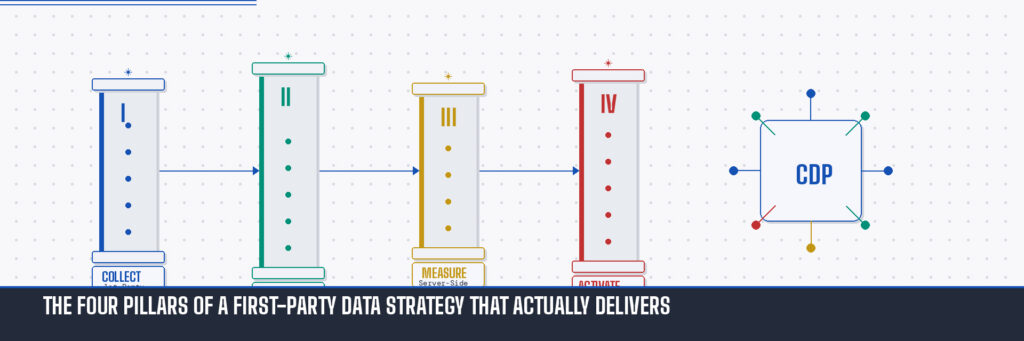
A durable first-party data strategy runs on four interconnected components. Missing any one of them creates gaps the others can’t compensate for.
Pillar 1: Systematic Collection
First-party data doesn’t collect itself. You need deliberate touchpoints across every owned channel that capture consented data in exchange for something genuinely useful.
The channels that work best: email opt-ins with a real value exchange, gated content where the quality justifies sharing contact information, loyalty and membership programs where customers actively choose to share preference data, product configurators and assessment tools that require input to return results, and progressive profiling that builds data over time across multiple interactions.
Email newsletters are used by 63% of advertisers as the most effective first-party data collection channel. That’s not an accident – email is consensual, direct, owned, and produces behavioural data that compounds into actual customer intelligence over time.
Pillar 2: Unified Infrastructure via CDP
Collected data only becomes useful when it’s connected. Most marketing stacks have customer data sitting in separate silos – your email platform knows about email behaviour, your CRM knows about sales interactions, your website analytics knows about on-site behaviour. None of them talks to each other at the customer level.
A Customer Data Platform (CDP) is the connective layer that fixes this. It ingests data from every source, resolves identities across touchpoints, and creates unified customer profiles that every tool in your stack can then activate against.
72% of marketers worldwide now use CDPs alongside other tools, according to Salesforce’s State of Marketing. Enterprise CDP adoption sits at 78% among large companies. The technology has moved from early-adopter to table stakes in about three years.
The most important CDP use case for immediate ROI: paid media optimisation through audience suppression and first-party segment activation. Suppressing existing customers from acquisition campaigns alone delivers measurable CAC improvement within a single campaign cycle.
Pillar 3: Server-Side Tracking
Browser-based tracking is broken – not theoretically, actually. Ad blockers, ITP, cookie deletion policies, and GDPR consent rejection rates all eat away at client-side data collection in ways that skew your analytics without showing up as obvious errors.
Server-side tracking moves the data collection from the visitor’s browser to your server, sending events directly to ad platforms and analytics tools from there. It bypasses browser-level blocking and produces more accurate conversion data.
Server-side tracking captures 25-35% more conversions than browser pixel setups, according to Improvado’s 2026 Cookie-less Attribution Guide. In practical terms: if you’re running Google Ads or Meta campaigns without server-side enhanced conversions, your reported ROAS is understated, and your optimisation is working from incomplete data.
Pillar 4: Privacy-First Measurement
Individual-level attribution is becoming less reliable by design. 76% of brands are now investing in new forms of multi-touch attribution, according to the IAB State of Data 2024.
The two methodologies getting the most adoption are Marketing Mix Modelling (MMM) – a statistical methodology that quantifies channel contribution using aggregate data without cookies – and Incrementality Testing, which measures whether a specific marketing investment actually caused a behaviour change rather than correlating with it. Neither requires a perfect data foundation to start. You can run incrementality tests with the data you have today while building toward a more complete first-party infrastructure.
The Channels That Feed First-Party Data Best
Understanding which channels produce the most valuable first-party data changes how you think about content investment.
Email remains the highest-leverage channel. It produces consented contact data, behavioural engagement data, and it’s fully owned. No algorithm change affects your list. 63% of advertisers say email is their most effective first-party data collection channel. If your email list growth rate is flat or declining, that’s the first thing to fix.
Gated tools, calculators, and assessments produce exceptionally high-quality zero-party data because the person filling them out is actively declaring something about themselves. A maturity assessment, a budget calculator, a competitive audit tool – these generate consented, self-reported data that’s more accurate than any behavioural inference. Our piece on The Zero-Click Content Strategy covers how tool-based content also travels well in dark social channels – so one asset serves both distribution and data collection.
Loyalty and community programs produce data people actively choose to share because there’s a clear value exchange. The behavioural data from loyalty members is also more consistent and richer than anonymous visitor data.
Social platforms as capture surfaces are underused for first-party data. Social SEO content that drives platform-native engagement can funnel into email opt-ins, webinar registrations, and gated content downloads. Our piece on Social SEO: How to Rank on TikTok, YouTube, Instagram, and Beyond in 2026 covers the distribution mechanics – the key is connecting that distribution to an owned data capture step.
There’s also an AI discovery angle worth noting here. 87% of buyers say AI search has changed how they research software, and the same content that captures first-party data through gating can also build brand citation frequency in AI-generated answers. We covered that dynamic in depth in GEO vs. SEO: How to Get Your Content Cited by ChatGPT, Perplexity, and Google AI Overviews.
And if you want to understand how personalisation built on first-party data plays out at the commerce layer, our piece on Beyond the Persona: How Real-Time Intent Mapping and Mobile AI Chatbots Changed Retail Commerce covers exactly that.
Your 90-Day Action Plan
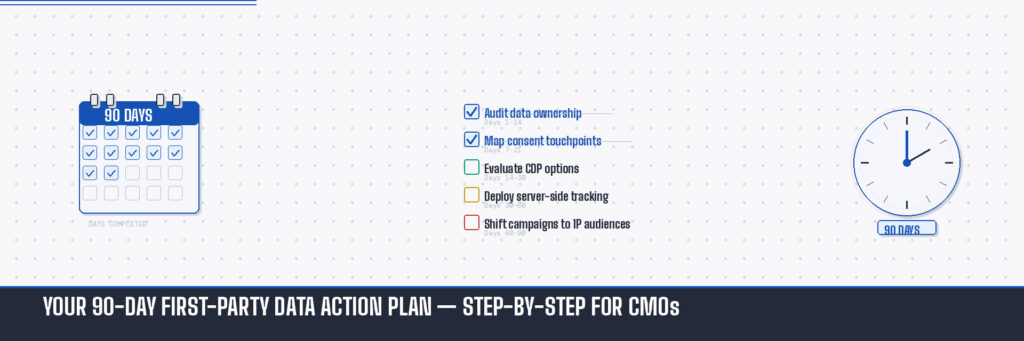
Here’s what actually needs to happen, in order, within a realistic timeframe.
Step 1: Audit What Data You Actually Own (Days 1-14)
Before building anything, run an honest inventory. Pull together your team and answer these questions:
- Where does your customer contact data live – and do you control it, or does a platform?
- What behavioural data are you collecting on your own properties, and is it persisting across sessions?
- What consent records do you have for the data you hold – are they legally defensible under GDPR, CCPA, and applicable local regulations?
- How many of your “owned” audiences are actually rented – audiences that exist inside Meta, Google, or LinkedIn that you can’t export or activate elsewhere?
Map the answers. The gaps will tell you exactly where the infrastructure work needs to start. Don’t skip this step in a rush to implement tools.
Step 2: Map Your Consent Touchpoints (Days 7-21)
Every form, pop-up, gating mechanism, and data collection point on your owned properties needs to be reviewed against two questions: Is the consent language clear and specific? Is the consent being recorded and stored in a format you can retrieve and prove?
Check your privacy policy, cookie banners, and form copy against the current requirements for the jurisdictions your audience sits in. If you’re selling to European buyers and your cookie banner is pre-ticked, you have an active compliance risk. Fix those before building on top of them.
Step 3: Evaluate CDP Readiness (Days 14-30)
You don’t necessarily need a CDP on day one. But you need to understand where your data unification gap is before you can design around it. Run through these three questions:
- Do your email platform, CRM, ad platforms, and website analytics share a common customer identifier?
- Can you currently suppress your existing customer list from paid acquisition campaigns across every platform you spend on?
- Can you build lookalike audiences from your actual best customers, not platform-inferred lookalikes?
If any answer is no, you have a CDP-shaped gap. The question then is whether you need an enterprise platform (Salesforce Data Cloud, Adobe Real-Time CDP) or whether a mid-market option (Segment, BlueConic) serves your current scale better.
Step 4: Deploy Server-Side Tracking (Days 30-60)
This is the most consistently underimplemented fix with the clearest near-term payoff. The practical steps:
- Set up a Google Tag Manager server-side container on a subdomain you control (e.g., tracking.yourdomain.com)
- Move your Google Ads, Meta, and analytics tags to fire from the server container rather than client-side
- Configure enhanced conversions for Google Ads and the Conversions API for Meta – both send hashed first-party signals to improve match rates without sharing raw PII
- Compare reported conversions before and after for 30 days – the improvement in signal recovery will make the business case for the rest of the program
If your team lacks the technical capacity to implement this internally, the agency cost pays back quickly.
Step 5: Shift One Campaign to First-Party Audience Targeting (Days 60-90)
Pick your largest active paid campaign and run a 30-day test with a first-party audience as the targeting foundation instead of platform-inferred audiences.
The mechanics: upload your CRM customer list as a suppression audience to remove existing customers from acquisition targeting, build a lookalike audience from your highest-LTV customer segment using your own data as the seed, run identical creative to both, and measure CAC, conversion rate, and ROAS for both. The outcome of this test gives you real numbers to bring into the next planning cycle – not a theoretical argument for first-party investment, but a controlled comparison from your own campaigns.
Actionable Takeaways
- Run the data ownership audit this week. Map exactly what data you control outright versus what lives inside platforms. The answer will be more uncomfortable than you expect, and that discomfort is the starting point.
- Fix your consent infrastructure before building on top of it. Every piece of data collected without clear, specific, stored consent is a liability, not an asset. Review your forms, banners, and policy language against current GDPR, CCPA, and applicable local standards.
- Implement server-side tracking in the next 30 days. 25-35% conversion signal recovery changes your reported ROAS and your campaign optimisation immediately. It’s the fastest ROI-positive move available.
- Treat email list growth as a primary KPI, not a secondary one. It’s your highest-durability first-party channel. If your current email list growth rate is flat or declining, fix that before anything else.
- Pick two or three CDP use cases before evaluating platforms. Start with what you want to do – suppress customers from acquisition, build lookalikes from best accounts, personalise by lifecycle stage – and work backwards to what infrastructure enables that.
- Bring MMM or incrementality testing into your measurement stack this year. 76% of brands are already investing in new attribution frameworks. Individual-level attribution is structurally degrading. Building toward aggregate measurement now, while you still have some individual-level data to calibrate against, is significantly easier than doing it after the individual data is gone.
The brands that come through this transition strongest won’t be the ones that had the most data in 2022. They’ll be the ones that spent 2025 and 2026 building infrastructure they actually own. That work starts with honest answers to uncomfortable questions about what you currently control. The 90-day plan above is one structured way through it.
Reference Sources:
- YouGov/Taboola Advertiser Cookie Readiness Study, May 2024
- Cookie-Less Marketing Statistics 2026 – Sci-Tech Today
- First-Party Data Statistics 2026 – Omnibound
- GDPR Fines 2026 – Improvado
- DLA Piper GDPR Fines and Data Breach Survey January 2025
- Cookieless Marketing Playbook 2026 – Markhub24
- First-Party Data Statistics 2026 – TechRT
- CDP Use Cases – CDP.com
- Best CDP Use Cases – Coffee + Dunn
- CDP Use Cases for Marketers – Insider
- Salesforce State of Marketing, 9th Edition
- IAB State of Data 2024
- First-Party Data Adoption Statistics – Scopic Studios