
In today’s fast-paced digital world, customers no longer follow a straight path. They jump between apps, websites, emails, and social feeds, expecting brands to meet them exactly where they are. That’s where AI-powered dynamic customer journeys come in. These aren’t rigid maps but living, breathing experiences that shift in real time based on what a customer does next. By mastering predictive personalisation, marketers can anticipate customer needs before they are expressed, thereby boosting engagement and sales. This guide breaks it down step by step, with fresh execution tips you can apply today.
Imagine scrolling through your favourite shopping app, only to see recommendations that feel eerily spot-on—like they read your mind before you even typed a search. That’s the magic of AI-powered dynamic customer journeys in 2026, where predictive personalisation doesn’t just guess your next move; it anticipates it, turning casual browsers into loyal buyers overnight. Ready to make this your brand’s superpower?
Think of it like a smart GPS for shopping or service. Traditional funnels treat everyone the same – awareness, consideration, purchase. But AI flips this. It uses data patterns to create unique paths, predicting if someone will buy, churn, or need support. Brands like Netflix or Amazon nailed this years ago, but in 2026, it’s table stakes for every business, especially in India with our mobile-first crowd.
What Makes Dynamic Journeys Different?
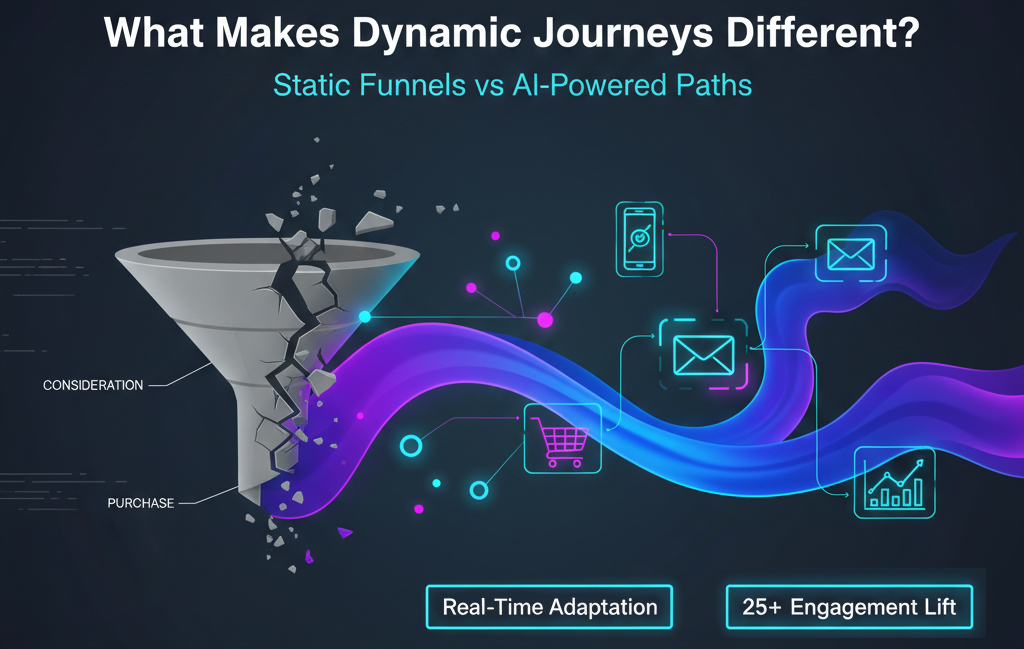
Static journeys assume customers move linearly. Dynamic ones adapt on the fly. Say a user browses shoes on your site but switches to a review app. AI spots this, sends a personalised WhatsApp nudge with matching deals, and tweaks the next email based on their hesitation signals.
Predictive personalisation powers this magic. AI crunches past behaviour, session data, and external signals—like weather or location—to forecast actions. It’s not guesswork; machine learning models hit 80-90% accuracy on next-best offers.
Why now? Tools are cheaper, data is richer, and privacy laws push smarter use of first-party info. For Indian marketers, this means hyper-local wins: Hinglish content for Tier 2 cities or festival-timed predictions during Diwali rushes.
Ready to build one? Follow these steps:
Step 1: Map Your Current Customer Data Flow
Start simple. Don’t chase fancy AI yet; audit what data you have.
- Collect touchpoints: List every interaction—site visits, app opens, email clicks, ad views. Use Google Analytics to track cross-device paths.
- Tag behaviours: Label actions like “viewed product,” “added to cart,” or “abandoned.” Tools like Google Tag Manager make this easy.
- Spot gaps: Where do customers drop? High bounce on mobile? AI thrives on clean signals here.
Execution Tip: Spend one week exporting data into a Google Sheet. Columns: User ID, Timestamp, Action, Channel. This baseline feeds your AI later. Expect 20% quick wins from fixing leaks alone.
Example: An e-commerce site found 40% cart abandons tied to slow loads on Jio networks. They prioritised mobile tweaks first.
Step 2: Choose Predictive Tools That Scale
Pick platforms matching your stack. No need for enterprise budgets.
| Tool | Best For | Pricing (2026 Est.) | India Fit |
|---|---|---|---|
| Google Analytics 4 + BigQuery | Free predictions on user lifetime value | Free tier ample | Ties to Google Ads seamlessly |
| HubSpot AI (Breeze) | Email/SMS journeys | $20/month starter | Regional language support |
| Klaviyo | E-com predictions | $45/month | Shopify integration for Indian sellers |
| Zapier + OpenAI | Custom automations | $20/month | No-code for SMBs |
Execution Steps:
- Sign up for GA4 if not already. Enable predictive metrics like churn probability.
- Connect to a CDP (Customer Data Platform) like Twilio Segment—free for small volumes.
- Test one prediction: “Likelihood to purchase in 7 days.” Run A/B on the top segment.
Fresh Angle: In India, blend with UPI data. Predict buys when users check payments mid-session.
Step 3: Build Dynamic Journey Blueprints
Design fluid paths, not funnels. Use “if-then” logic powered by predictions.
Core Framework:
- Awareness: Predict interest from searches. Show personalised content like “Top 5 laptops for creators” if they linger on tech pages.
- Consideration: Spot hesitation (e.g., multiple views). Trigger chatbots with “Need help comparing?”
- Decision: High purchase probability? Dynamic pricing or urgency: “2 left at your size.”
- Retention: Post-buy predictions for upsells. “Loved those shoes? Try matching bags.”
Step-by-Step Build:
- Sketch in Lucidchart: Boxes for stages, arrows for triggers.
- Code triggers in your tool: If churn score >70%, send win-back SMS.
- Add real-time: Use webhooks for instant site behaviour response.
- Test loop: 100 users, measure lift in conversion.
Case: Flipkart uses this for “You might like” during festive sales, lifting AOV by 15%.
Step 4: Layer in Predictive Analytics Deep Dive
This is the brain. AI learns from patterns to forecast.
How It Works Simply:
- Feed historical data: 6 months of user actions.
- Train model: Tools auto-build clusters (e.g., “bargain hunters”).
- Score live: Each visitor gets a 0-100 propensity score.
Hands-On Setup:
- In GA4: Go to Admin > Predictive Audiences. Export segments.
- Import to email tool: Target “high-value” with exclusive offers.
- Measure: Track uplift vs. control group.
Pro Tip: Combine with external data ethically – SEO trends show rising voice searches? Predict for Hindi queries.
India Twist: Predict monsoon impacts. E-com sites push rain gear to coastal users proactively.
Step 5: Activate Real-Time Personalisation
Dynamics shine here – adapt mid-journey.
Tactics:
- Micro-Moments: User pauses on pricing? Pop “Budget options inside.”
- Cross-Channel: Email opened on phone? Follow with app push.
- Contextual: Location in Mumbai traffic? Shorten videos.
Implementation:
- Install client-side scripts (e.g., Google Optimise).
- Set rules: If session >5 mins on category, recommend top 3.
- A/B test variants weekly.
Results? 25% engagement jumps, per global benchmarks adapted for India.
Step 6: Ensure Privacy and Compliance
Predictive power demands trust. India’s DPDP Act mirrors GDPR.
Checklist:
- Use zero-party data: Quizzes for preferences.
- Anonymize: Hash IDs, no raw PII.
- Consent first: Pop-ups for tracking.
- Audit logs: Prove decisions.
Link to AI ethics in marketing—future-proof your stack.
Step 7: Measure, Iterate, Scale
No set-it-forget-it. Build feedback loops.
KPIs:
- Journey completion rate (+15% target).
- Personalisation ROI: Revenue per personalised user.
- Prediction accuracy: Tune models quarterly.
Weekly Routine:
- Review dashboards.
- Retrain on new data.
- Scale winners: Roll to full traffic.
Real-World Wins and Pitfalls
Success Story: A Delhi fashion brand used GA4 predictions for Diwali. High-intent segment got dynamic bundles—sales up 32%. They started with 10% traffic.
Pitfall: Over-personalisation creeps out. Cap at 3 tailored touches per session.
Another: An Indian bank predicted loan needs from app logins. SMS with pre-filled apps converted 18% better.
Tools and Integrations for Marketers
- Free Stack: GA4 + Google Ads + WhatsApp Business API.
- Paid Power: MoEngage for regional journeys.
- No-Code Hack: Airtable for data, Make.com for flows.
Budget: Start under ₹5,000/month.
Future Shifts in 2026
Agentic AI takes over—systems decide and act autonomously. Voice commerce explodes with multilingual models. Watch for AR try-ons predicting style fits.
For your business, test one journey this month. Track, tweak, triumph.
Pick your top leak (carts? bounces?). Build a 3-step predictive flow. Share results in comments – let’s discuss on social media strategies.
