
You ranked #1 on Google. And nobody came.
Not because your content was bad. Not because your SEO was broken. But because the person asking the question never saw your blue link. They got a generated answer at the top of the page, read it, and moved on.
This is the reality of search in 2026, and if you’re a content creator, marketer, or business owner trying to stay visible online, this shift should get your full attention.
The fix isn’t panic. It’s a discipline called Generative Engine Optimization, or GEO. And understanding it could be the difference between your brand showing up in AI-generated answers and your brand being invisible to an entirely new class of searchers.
Before you read further – if you haven’t already gone through our piece on the Zero-Click Content Strategy, do that first. This article picks up right where that one leaves off.
What Is GEO, Actually?
GEO – Generative Engine Optimization – is the practice of structuring your content so that AI platforms like ChatGPT, Perplexity, Google AI Overviews, and Claude select it as a source when generating answers for users.
The term was introduced in a 2023 research paper by Princeton University, Georgia Tech, and IIT Delhi – making it one of the few new marketing concepts that didn’t originate in a software company’s blog post. That paper also delivered a concrete finding worth paying attention to: applying GEO techniques can boost your visibility in AI-generated responses by up to 40%.
Traditional SEO gets you ranked on a list. GEO gets you cited inside an answer.
That difference matters more than it sounds. When Google ranks you at #3, the user still has to choose to click. When an AI cites you, your data, your framing, and your authority become part of the answer itself. The user absorbs your expertise even if they never visit your site.
That’s both an opportunity and a threat. And most brands haven’t figured out which it is yet.
The Numbers Behind the Shift
Let’s put some real scale on this before diving into tactics.
According to Previsible’s 2025 AI Traffic Report, AI-referred sessions – meaning visits to websites that came from users clicking links inside AI-generated responses – jumped 527% year-over-year in the first five months of 2025 alone.
ChatGPT now processes 2.5 billion prompts per day. Perplexity has crossed 780 million monthly queries with 45 million active users. Google AI Overviews, after its May 2025 expansion, now reaches users in over 200 countries across 40+ languages.
Here’s the thing that should genuinely concern you if you run a content-heavy site: a Forrester study found that 89% of B2B buyers now use generative AI as a primary source of self-guided research during their purchasing journey. These aren’t casual browsers. These are decision-makers whose first touchpoint with your brand may now be a ChatGPT response rather than your website.
And the window AI engines use to select sources is incredibly narrow. Unlike Google, which shows ten blue links per page, LLMs typically cite only 2 to 7 domains per response. If you’re not in those few, you don’t exist.
GEO vs. SEO: What Actually Changes
People keep asking whether GEO replaces SEO. It doesn’t. But it changes the rules significantly enough that treating your existing SEO strategy as sufficient is a real mistake.
Here’s a clean breakdown of the core differences:
| What You’re Optimizing For | Traditional SEO | GEO |
|---|---|---|
| Goal | Rank in a list of blue links | Be cited inside an AI-generated answer |
| Success metric | Click-through rate, organic rank | Citation frequency, Share of Model |
| Content signals | Keywords, backlinks, page speed | Structured answers, stats, authority |
| User behavior | User chooses to click | User absorbs your content without clicking |
| Primary engines | Google, Bing | ChatGPT, Perplexity, Google AI Overviews |
The core SEO fundamentals still apply. A website that’s technically broken, slow, or thin on authority won’t get cited by AI systems any more than it ranks on Google. GEO builds on top of your SEO foundation – it doesn’t replace it.
What GEO adds is a set of specific requirements around how content is structured, how citable individual statements are, and how authoritative your brand looks across the entire web – not just on your own site.
We’ve written extensively about how AI is reshaping SEO strategy and what AI-driven search engines mean for your 2026 content plan. GEO is the practical answer to both of those questions.
How AI Engines Decide What to Cite
To optimize for AI citation, you need to understand what these systems are actually doing when they generate a response.
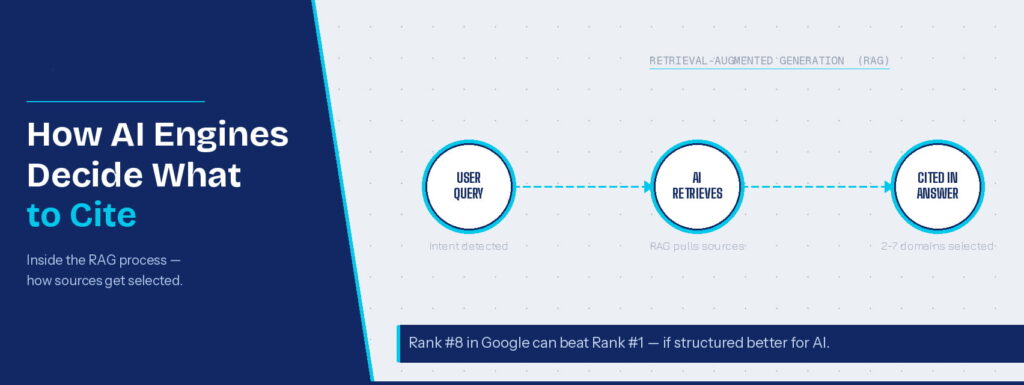
Most major AI search platforms – Perplexity, Google AI Overviews, ChatGPT’s browsing mode – use a technology called Retrieval-Augmented Generation (RAG). The process works in two steps:
- The system retrieves relevant web pages in real time based on the user’s query
- It synthesizes information from those pages into a fluid, natural-language answer
The AI doesn’t just grab the highest-ranking page. It evaluates which sources contain the clearest, most structured, most citable information for the specific question being asked. A page that ranks #8 on Google can get cited in an AI response ahead of the page sitting at #1, if its content is better structured for AI synthesis.
The Princeton research on GEO identified specific content interventions that move the needle. Two stood out: adding statistics and adding authoritative quotations. These two alone improved AI visibility by 41% and 28% respectively in controlled tests. Not because AI systems are impressed by numbers for their own sake, but because statistical claims and expert quotes are the kind of concrete, verifiable statements that AI systems can responsibly include in a synthesized answer.
Vague, opinionated, hedged content is hard to cite. Specific, sourced, structured content is easy to cite.
Five Things You Can Do Right Now
This is where most GEO guides start listing twenty tactics and overwhelm you with things to do over the next six months. I’d rather give you five things that actually move the needle and that you can start applying to your next article.
1. Answer the Question in Your First 200 Words
AI systems like Perplexity and Google AI Overviews evaluate the opening of a page heavily for real-time retrieval queries. If your article takes four paragraphs to get to the point, those systems have already moved on to a competitor’s page that answered directly.
This is a structural shift from traditional long-form content writing, where you build context before delivering the answer. With GEO, the answer comes first. Context and depth follow.
Think of it this way: write your introduction as if it’s the answer an AI needs to cite. Then write the rest of the article as the supporting detail a human reader needs to trust you.
2. Include Real Data With Named Sources
We’ve already covered how predictive analytics is changing marketing strategy. The same principle applies here: specificity beats generality every time.
“AI search is growing fast” won’t get cited. “AI-referred sessions grew 527% year-over-year in the first half of 2025, according to Previsible’s AI Traffic Report” will.
Name the source. Give the year. Link to it where you can. This isn’t just good journalism – it’s what makes your content citation-worthy to an AI system deciding which sources to reference.
According to research published in Search Engine Land, brands with strong data-backed content that’s consistently attributed to named sources see significantly higher citation rates across AI platforms. The pattern makes sense. AI systems are built to be accurate. They select sources that help them be accurate.
3. Build Brand Mentions Across the Web
Here’s a thing that surprises most content creators: AI citation isn’t just about your own website. It’s about how broadly your brand is discussed across the web.
Reddit, LinkedIn, and YouTube were among the top sources cited by major LLMs in October 2025. Customer reviews on platforms like G2 or Trustpilot, third-party editorial mentions, and community discussions where your brand is genuinely recommended all feed AI systems a clearer picture of your authority.
This is what GEO practitioners call “earned mentions” – and they matter because AI engines look for consistency. If multiple independent sources discuss your brand in a relevant context, the AI has stronger signal to include you in its response.
The practical implication: your content strategy can’t stop at your own blog. You need a presence in the conversations happening off your site.
4. Structure Your Content for Machine Readability
AI systems that use RAG retrieve and parse content at speed. Content that’s clearly structured – with explicit definitions, logical headings, FAQ sections, and clean paragraph breaks – gets processed more accurately than dense, unbroken text.
FAQ schema pages, in particular, get disproportionately more AI citations across most verticals. If your article answers ten related questions buried in flowing prose, consider surfacing them as an explicit FAQ section at the end. This single change can significantly improve how AI systems extract and cite your content.
Schema markup matters here too. Mark up your author information, publication dates, and article type correctly. AI systems – especially Google AI Overviews – use these structured signals when deciding which sources to trust for a given query.
5. Keep Content Fresh
Google’s AI Overview system weights recent content for time-sensitive queries. A visible “Last Updated” date, current statistics, and fresh examples all tell AI systems that your content reflects the current state of the topic.
This is one area where small updates to existing articles pay disproportionate dividends. Adding a “What changed in 2026” section to a piece you wrote in 2024 can reactivate it for AI citation without requiring a full rewrite.
We saw this in our own coverage – updating the AI and customer journey personalization piece with 2026-specific framing immediately made it more competitive for related queries in AI platforms.
The Measurement Problem (and How to Deal With It)
Here’s something nobody talks about enough: your existing analytics are blind to GEO performance.
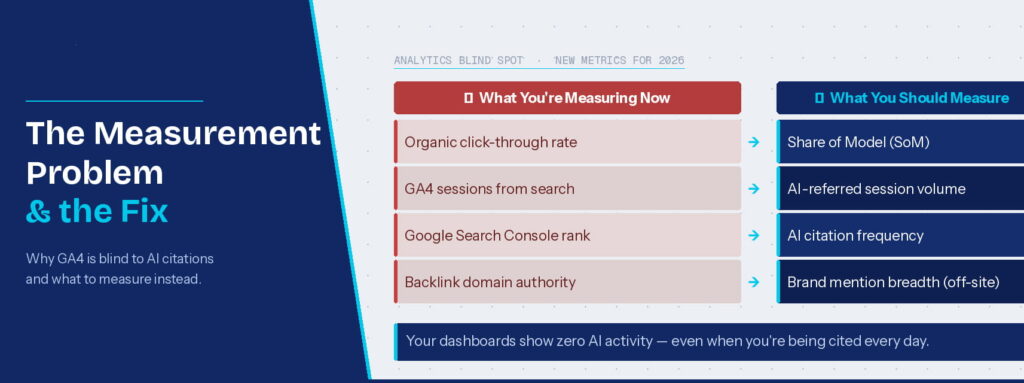
GA4, Google Search Console – these tools only track what happens after a click. They cannot tell you how often your brand is being mentioned in ChatGPT responses, or how your content is being cited in a Perplexity answer for a relevant query.
As Search Engine Land noted, this creates a “measurement blind spot.” You could be the most-cited brand in your niche inside AI-generated responses and your standard dashboards would show zero activity from it – until a user clicks a cited link, which isn’t always even an option in some AI response formats.
The new metric you need to care about is Share of Model (SoM) – how often your brand appears in AI-generated responses for queries relevant to your business, compared to your competitors. This is what GEO tools like Semrush’s Enterprise AIO, Otterly.ai, and Ahrefs Brand Radar are built to track.
A simple manual check you can do today: open ChatGPT, Perplexity, and Google AI Overviews. Search for five questions your ideal reader would ask. See which brands get cited. If it’s not you, that’s your baseline. Run it again in 90 days after implementing GEO practices.
The Ethical Side You Shouldn’t Ignore
There’s a version of GEO that’s pure gaming – keyword stuffing dressed up in new clothes, trying to trick AI systems the same way bad actors tried to trick Google two decades ago. That approach won’t work and it’s worth saying why.
AI citation systems are getting more sophisticated at evaluating genuine authority versus manufactured signals. And the ethical implications of AI in content and marketing are real – both for users who rely on AI-generated answers and for publishers whose content is being synthesized without always receiving attribution.
The GEO practices that work long-term are the ones that make your content genuinely more useful to the people asking questions. Direct answers, real data, named sources, structured presentation – these help readers and they help AI systems. That’s not a coincidence.
If you want a deeper read on navigating data privacy and ethical AI in your marketing strategy, that’s worth your time too. As AI systems gather more data to serve more personalized answers, the questions around consent and transparency are only going to get louder.
The Competitive Window Is Open – But Not Forever
One thing the data makes clear: most brands have not started this yet.
According to one industry snapshot from Marketing LTB, 26% of brands had zero mentions in AI Overviews in a sector-wide audit. The brands dominating AI citations in most industries right now are the ones with strong existing content authority – the top 50 brands account for a disproportionate share of all AI Overview sources.
But that’s because most small and mid-sized publishers haven’t adapted yet. The brands that treat GEO as a priority in 2026 will be the brands that AI systems default to citing in 2027 and beyond. Citation authority, like domain authority before it, compounds over time.
As Relato’s 2026 GEO analysis put it: the framing among serious digital marketers has shifted from “I care about Google rankings” to “I care about whether AI tools like ChatGPT or Perplexity mention the brands I work with.”
That shift is happening whether or not you’ve made a conscious decision to be part of it.
A Quick GEO Checklist for Your Next Article
Before you hit publish on any piece of content, run it through these questions:
- Does the first 200 words directly answer the core question? If someone read only the intro, would they get the answer?
- Are there at least two specific data points with named sources? “Experts say” doesn’t count.
- Is there a clear definition of the main topic? AI systems frequently cite definition statements.
- Are headings written as questions or clear topic statements? This helps AI systems match content to conversational queries.
- Is there a FAQ section or explicit Q&A structure? Even two or three questions at the end helps.
- Is the author’s expertise clearly stated? E-E-A-T – Experience, Expertise, Authoritativeness, Trustworthiness – still matters. AI systems favor content from verifiable experts.
- Does the content include external links to primary sources? Linking to research, official data, and original reports signals that you’re building on real evidence.
Where This Is All Going
The honest answer is that no one fully knows. AI search is evolving fast enough that specific platform behaviors in 2025 may look quite different by late 2026. OpenAI launched Operator – an AI agent that doesn’t just answer questions but browses and completes tasks autonomously – in January 2026. As agentic AI search matures, content with machine-readable structured data will become even more important.
What’s stable is the underlying direction. Users are increasingly getting answers from AI rather than clicking through to find them. The brands that get cited in those answers will have a form of visibility that can’t be gamed by paid ads and can’t be replicated overnight.
We’ve asked the question before: what happens when ChatGPT replaces search engines? The answer isn’t that the search disappears. It’s that the contract between content creators and search systems changes. GEO is how you operate under the new contract.
Start with one article. Apply the checklist above. Run the manual citation audit in ChatGPT and Perplexity. See where you stand.
Then build from there.
Frequently Asked Questions About GEO
What is GEO in simple terms? GEO stands for Generative Engine Optimization. It’s the practice of structuring your content so AI systems like ChatGPT, Perplexity, and Google AI Overviews cite it when generating answers for users.
Does GEO replace SEO? No. GEO builds on your existing SEO foundation. A technically sound, authoritative website is still the starting point. GEO adds specific requirements around content structure and citation-readiness that traditional SEO doesn’t address.
How do I know if my content is being cited by AI? Your standard analytics won’t show this. Use tools like Otterly.ai, Semrush Enterprise AIO, or Ahrefs Brand Radar to track AI citation frequency. You can also do manual checks by searching relevant queries directly in ChatGPT and Perplexity.
What types of content get cited most by AI systems? Content with specific data points, named sources, clear definitions, FAQ structures, and strong author authority consistently performs best. Content that directly answers a question in the opening paragraph is also favored by AI retrieval systems.
How long does it take to see GEO results? Unlike paid ads, GEO is not immediate. AI systems recrawl and update their knowledge bases on varying schedules. Budget for a 60–90 day baseline before concluding, and plan for ongoing optimization rather than a one-time effort.
